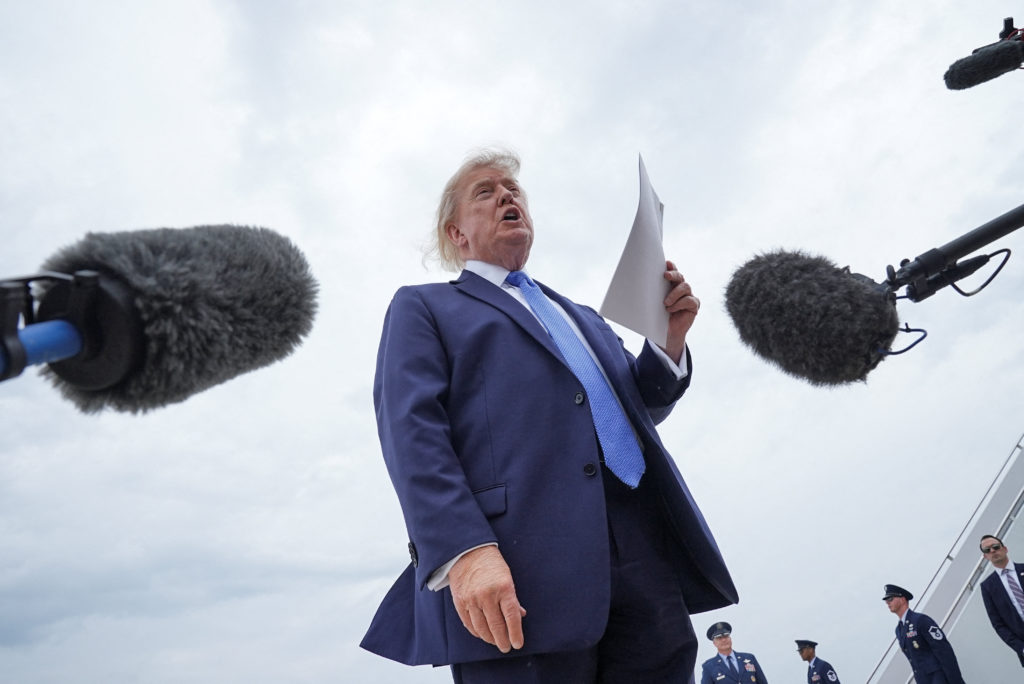
President Donald Trump on Friday stated that the current deployment of the aircraft carrier USS Abraham Lincoln is "not nearly long enough," downplaying concerns regarding the welfare of sailors who have been at sea for nearly nine months. Speaking to reporters before a trip to New York, the president refuted claims that family members of the crew have expressed alarm over the duration of the mission. Trump noted that the ship is scheduled to be replaced shortly by a similar vessel.
The USS Abraham Lincoln has been deployed for more than 260 days in support of U.S. military operations against Iran. The deployment comes amid a Navy blockade of Iranian ports in the Strait of Hormuz, a mission Defense Secretary Pete Hegseth stated the military could maintain "indefinitely." While the USS Lincoln remains one of two carriers in the Middle East, the USS George Washington left Vietnam last week to serve as its replacement.
Democratic lawmakers, including Sens. Richard Blumenthal (D-CT) and Ruben Gallego (D-AZ), have called for Pentagon accountability concerning mental health and supply conditions on the ship. In response, Secretary Hegseth characterized these reports as "completely misrepresented." Rep. Jason Crow (D-CO) criticized the president’s remarks on social media, stating that the comments indicated a lack of concern for service members and their families.
The scale of the military commitment involves two carrier strike groups currently stationed in the Middle East to manage the ongoing conflict with Iran. While the Navy reports it has not seen a rise in suicidal ideation, officials confirmed one incident in early August where a sailor went overboard and required off-ship medical care. The Navy has declined to release specific data on mental health trends or confirm if the incident was a self-harm attempt, citing operational security and patient privacy.
The situation sets a precedent for how the U.S. Navy manages its fleet during prolonged regional conflicts. The transition between the USS Lincoln and the USS George Washington will determine when the current crew can return to their homeports. Residents in military communities and families of the crew will notice the concrete impact of these decisions through the presence or absence of their relatives and the availability of support services. The Pentagon and U.S. Central Command continue to monitor ship conditions as the replacement vessel arrives.