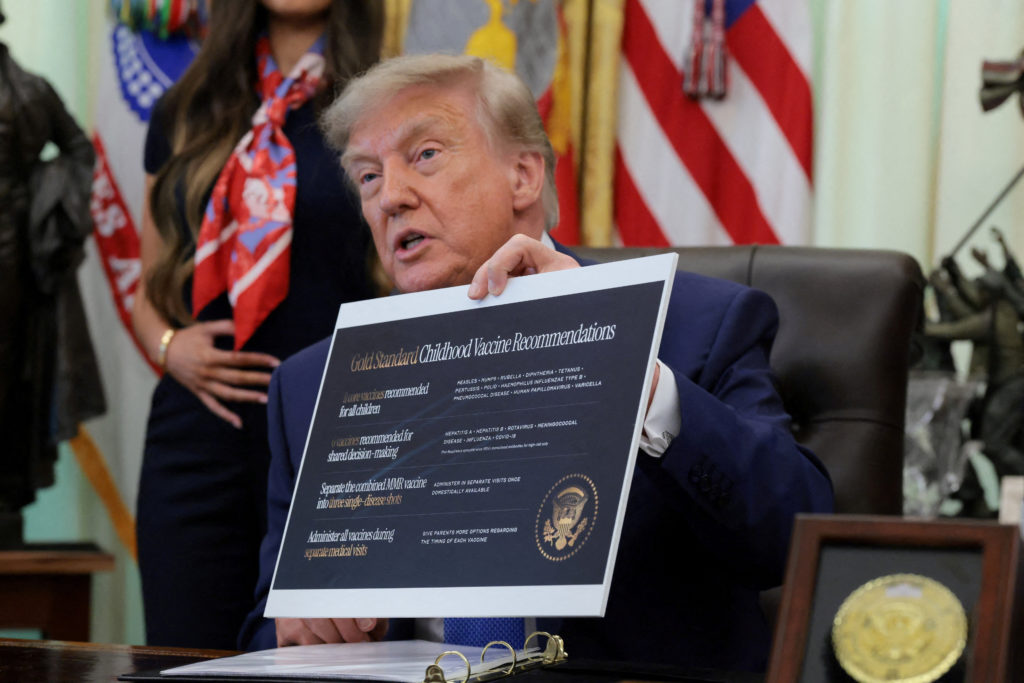
President Donald Trump signed an executive order on Monday calling for a reduction in the number of childhood vaccines and a new schedule that spaces out immunizations across separate doctor visits. The order specifically requests that the measles, mumps, and rubella (MMR) vaccine, which is currently administered as a single combined injection, be split into three individual shots.
The directive follows recent administrative changes, including the swearing-in of Todd Blanche as Attorney General on Monday. It also coincides with ongoing international developments, as the Trump administration's Board of Peace reported it is in discussions with Israel following Prime Minister Benjamin Netanyahu’s rejection of a Gaza peace plan proposed by the White House.
In addition to the vaccine order, the administration addressed several global events on Monday. Reports confirmed Tropical Storm Dolphin made landfall in eastern China. Domestically, federal data from the National Oceanic and Atmospheric Administration (NOAA) indicated that the contiguous United States experienced its hottest month on record in July, while wildfires continued to prompt evacuations across the western U.S. and Canada.
For households, this shift would mean a concrete change in time spent at medical facilities and potential adjustments to how insurance companies or Medicaid cover multiple individual office visits versus a single combined visit. The order seeks to move away from the current medical practice of combined shots, which healthcare providers use to ensure high completion rates for childhood immunity. By calling for fewer total vaccines and more time between them, the policy could change the timing of when children meet school and daycare entry requirements.
The knock-on effects could extend to the vaccine manufacturing industry and state health departments that manage immunization registries and public health mandates. A move to split the MMR vaccine would require manufacturers to adjust production to provide single-dose vials for each component, which may impact supply chains and inventory management at clinics. The source does not report a specific effective date for these changes or the immediate status of agency implementation. Next steps depend on how federal health agencies translate the executive order into specific regulatory guidance for doctors and insurers.