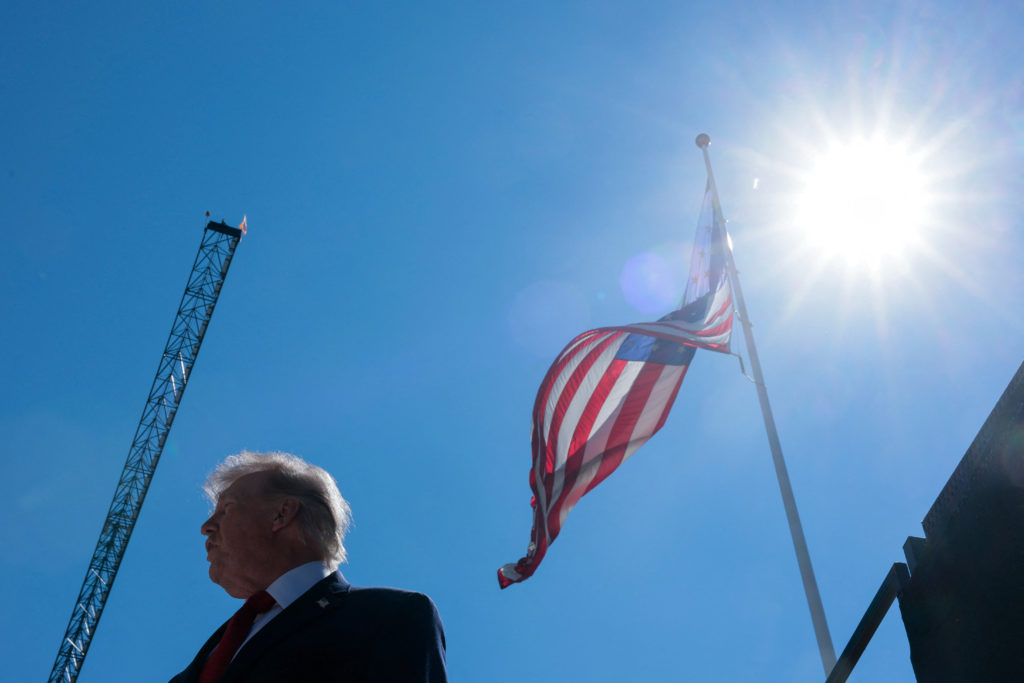
President Donald Trump expressed support for the construction of artificial intelligence (AI) plants and data centers during a meeting with cryptocurrency leaders at the White House this week. The president stated that such facilities provide significant tax revenue and employment opportunities, framing them as a necessary component for national security and the global competition for AI leadership.
The remarks come as candidates from both parties in several states face local opposition to data center developments. Voters in multiple districts have raised concerns regarding the impact of these large-scale facilities on utility bills, water supplies, and noise and air pollution. The National Republican Senatorial Committee (NRSC) issued a memo on Tuesday identifying voter frustration over data centers as a potential risk for candidates in contested races.
In Ohio, Democratic Sen. Sherrod Brown has released advertisements criticizing Republican candidate Jon Husted for his support of data centers, while local organizers collect signatures for a referendum to ban their construction. Similarly, in Nevada, Democrat Aaron Ford proposed halting new state tax breaks for the facilities, which he estimated at $200 million. In Texas, Governor Greg Abbott (R) recently shifted his stance, suggesting a review of energy usage and the removal of sales tax exemptions for data centers, a move President Trump described as a mistake.
The development of these centers involves significant financial commitments from both public and private sectors. In Nevada, candidates are debating the future of approximately $200 million in state tax incentives, while in Texas, Google recently announced a $40 billion investment in the industry. The outcome of these policy debates will determine whether technology companies or residential consumers bear the costs of the increased energy and infrastructure demands required to power AI and cloud computing services.
Beyond immediate utility costs, the issue sets a precedent for how states balance economic development with local resource management. While President Trump has secured a voluntary pledge from some tech companies to protect consumers from utility spikes, he is also pushing to streamline the construction of new power plants. However, since new power infrastructure cannot be built immediately, the primary focus remains on upcoming elections. In Ohio, voters are currently gathering signatures for a referendum, and candidates across the country will face voters in November who are weighing the economic benefits of AI infrastructure against local environmental and cost concerns.