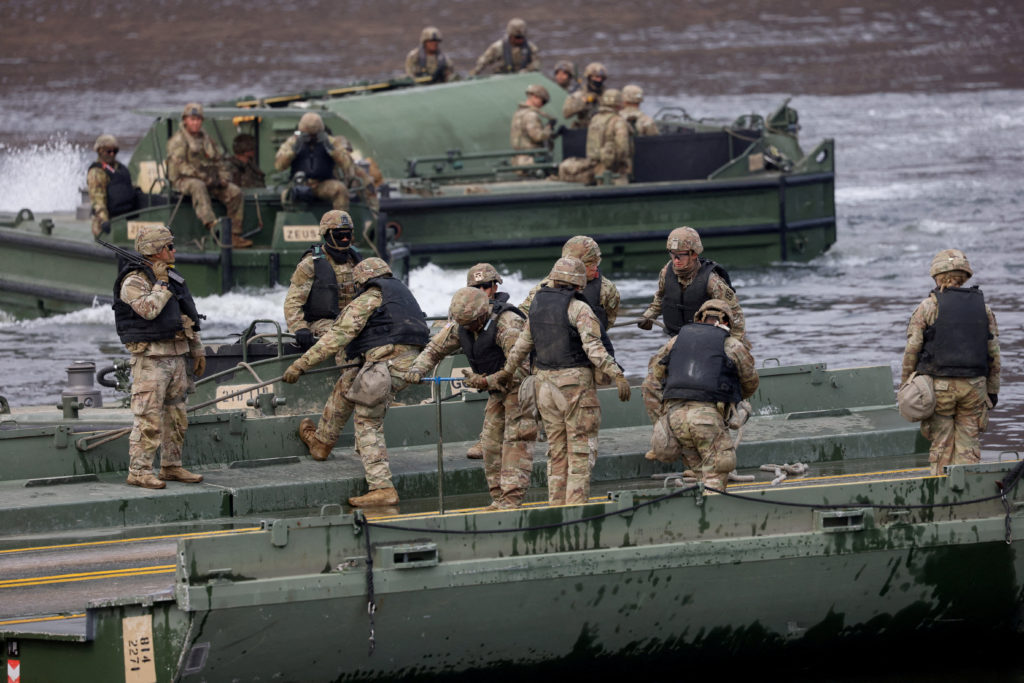
Joint military exercises between the United States and South Korea began on Monday as scheduled, despite a demand from President Donald Trump that they be scaled back. President Trump characterized the annual drills as "unnecessarily provocative" toward North Korea and expressed dissatisfaction with South Korean President Lee Jae-myung regarding a request for military assistance in Iran.
The exercises, known as Ulchi Freedom Shield, involve tens of thousands of personnel and are described by the U.S. military as a "defensive opportunity" to maintain readiness. While these drills have been held for 50 years to deter North Korean aggression, the president stated that they send an "inappropriate and hostile message" to North Korea. During the same period, President Trump expressed a desire to restart diplomacy with Kim Jong-un, noting on social media that the two "get along great."
President Trump also criticized South Korea for declining to assist in what he described as a "very easy military operation in Iran." He noted that the U.S. maintains 39,000 soldiers in South Korea for defense and questioned why the U.S. should continue this involvement if South Korea does not reciprocate in other regions. In response, the South Korean president’s office stated it was reviewing the comments and remained open to discussing assistance regarding Iran.
For the American public and military families, the potential scaling back of these annual "war games" could alter the training cycle for tens of thousands of troops. While proponents of restraint, such as Jennifer Kavanagh of Defense Priorities, argue that reducing these exercises could encourage South Korea to take more responsibility for its own defense, military planners like Frank Jannuzi of the Mansfield Foundation maintain that these drills are essential for deterring North Korean aggression. The immediate impact for service members is that current training remains in place, but future exercises may be reduced or cancelled depending on diplomatic negotiations.
The situation also sets a precedent for how the U.S. manages its relationships with allies by tying regional defense commitments to unrelated international conflicts. North Korea has already responded to the start of these exercises by launching missiles, a move that could affect regional security and future denuclearization talks. What happens next depends on the South Korean government's formal response to the request for aid in Iran and whether President Trump follows through on threats to scale back military commitments. No specific dates for future troop withdrawals were reported.