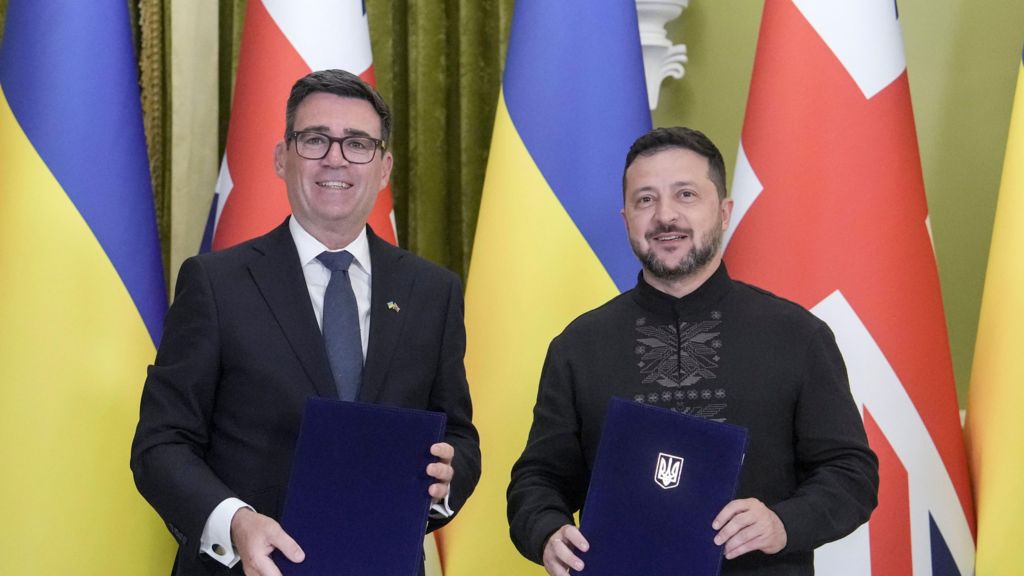
United Kingdom Prime Minister Andy Burnham announced plans to travel to the United States in September to discuss Ukraine’s defense requirements with U.S. President Donald Trump. Speaking in an interview with Bloomberg, Burnham stated it is "likely" he will attend the UN General Assembly in New York, which would mark his first U.S. visit since taking office in July. The Prime Minister stated he intends to coordinate with European leaders to lobby the U.S. administration for continued military support.
The announcement followed Burnham's first official international visit to Kyiv on Monday, where he met with Ukrainian President Volodymyr Zelensky. During the trip, the UK agreed to provide Ukraine with blueprints for British-made components of the Scalp missile, a French version of the UK's Storm Shadow cruise missile. These documents are intended to allow Ukraine to produce the long-range weapons within its own borders to counter ongoing Russian military actions.
Ukraine is currently seeking to secure 300 Patriot interceptor missiles before winter to protect its energy infrastructure from expected Russian strikes. While Ukraine has relied on American supplies for these systems, stockpiles have decreased due to the conflict in Iran. President Trump previously expressed hesitation regarding the domestic production of these systems in Ukraine, stating in July that the U.S. must be "very careful" about sharing such technology, despite earlier discussions about a production agreement.
The scale of the military aid involves high-technology cruise missiles and air defense systems worth billions of dollars. For the UK, the transfer of Scalp missile blueprints represents a shift toward enabling Ukrainian self-sufficiency in long-range strike capabilities. However, the U.S. position remains the primary factor in Ukraine's air defense, as the Patriot system is a proprietary American technology. President Trump's stated concern over "giving away" this technology suggests a potential change in how the U.S. manages military intellectual property and defense exports to allies in active conflict zones.
For international policy, Burnham’s planned September visit will test the influence of the "coalition of the willing"—a group involving the UK, France, and Germany—over U.S. foreign policy. Burnham indicated that if U.S. support remains restricted, he will seek solutions involving "other players" who could provide help. The diplomatic meetings are scheduled to coincide with the UN General Assembly in September, which will serve as the next major deadline for international leaders to coordinate defense strategies before the onset of winter in Eastern Europe.
Burnham also chaired a meeting with French President Emmanuel Macron and German Chancellor Friedrich Merz, where the leaders pledged to strengthen Kyiv's air defenses as an "urgent priority." The group also committed to further sanctions against Russia’s "shadow fleet" to limit the funds available for the Russian military. Burnham stated that the UK’s support would continue "for as long as it takes," describing Ukraine’s security as integral to the UK's own security.