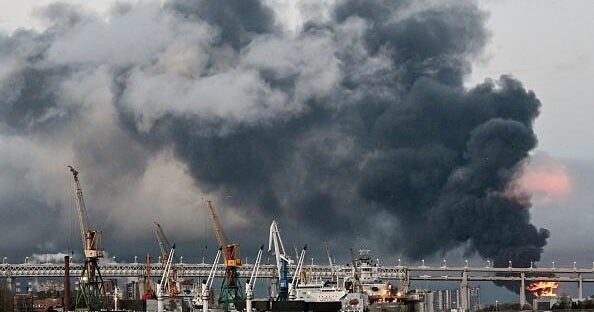
Ukraine launched a large-scale aerial attack against Russian territory on a Sunday, deploying more than 1,000 drones across 15 regions. The Russian Defense Ministry reported that its forces intercepted 1,015 drones over these regions, as well as the Black Sea and Crimea. The operation targeted industrial and logistical infrastructure, including oil facilities and data centers, marking one of the largest drone deployments by Kyiv since the conflict began.
The strikes occurred amid reported friction between the Ukrainian government and the U.S. administration. President Trump recently criticized Ukrainian President Volodymyr Zelenskyy and Kyiv's strategy of targeting Russian oil infrastructure. On the Friday night prior to the attack, President Trump signed an executive order waiving planned restrictions on Russia, citing U.S. national interests. While Mr. Trump told reporters on Saturday that his final decision on further sanctions remained undecided, he has recently waived tariffs for the largest buyers of Russian oil.
In St. Petersburg, local Governor Alexander Beglov reported that the strikes caused fires at the Petersburg Oil Terminal and the Ruchi oil depot. One person was killed and five others were wounded in the city. Private companies, including the retailer Ozon and the technology firm VK, confirmed that a logistics center and a data center were also targeted. Concurrently, local officials in Zaporizhzhia, Ukraine, reported that Russian attacks killed one woman and wounded at least two others, including a six-year-old girl.
President Zelenskyy, speaking on NBC’s "Meet the Press," stated that waiving sanctions would strengthen the Russian war effort and characterized siding with Moscow as a "historic mistake." He also reported that U.S.-Ukraine intelligence sharing had resumed after a period of being blocked. On social media, Zelenskyy accused Moscow of violating a regional "energy ceasefire" 76 times, noting that strikes on four Ukrainian regions had left tens of thousands of families without power.
The scale of the drone operation—involving over 1,000 aircraft—indicates a significant shift in the volume of aerial warfare. The impact extends to the global energy market and U.S. foreign policy, as the Trump administration navigates the balance between national interest and international sanctions. For U.S. taxpayers and policymakers, the resumption of intelligence sharing and the waiver of tariffs for major Russian oil buyers represent concrete changes in how the U.S. manages its involvement in the conflict. The shift in tariff policy affects the costs for international oil purchasers and the revenue flow to the Russian government.
The conflict's next steps involve diplomatic discussions and potential congressional oversight. Zelenskyy reported meeting with U.S. presidential envoys Steve Witkoff and Jared Kushner to discuss "next steps in diplomacy" following an October 9 meeting in Miami. Meanwhile, Rep. Michael Turner (R-OH) has called for a congressional probe into disruptions of Starlink, a satellite internet service that Zelenskyy identified as a critical factor in Ukraine's current inability to intercept some drones. No specific dates for further sanctions decisions or the conclusion of the Starlink investigation were reported.