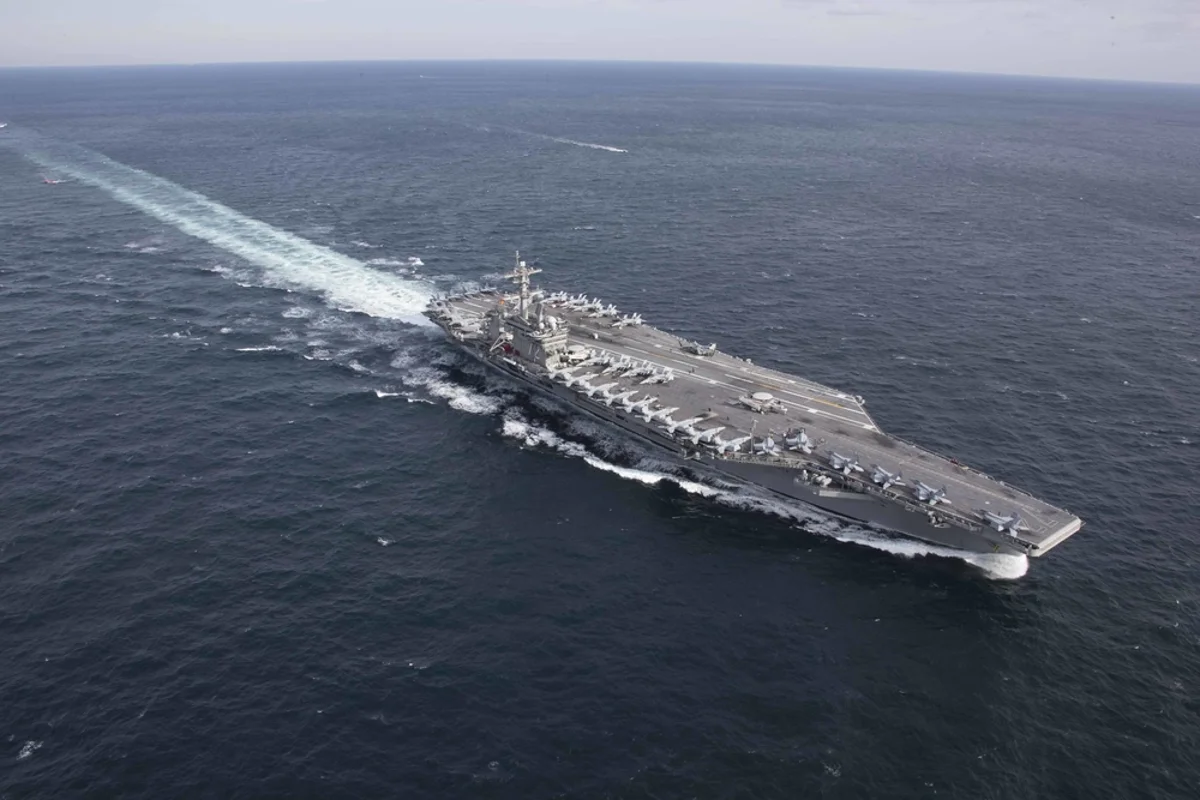
The aircraft carrier USS Abraham Lincoln is returning to the United States after more than 270 continuous days at sea, a duration the Navy identifies as a post-Vietnam War record. The deployment was marked by supply shortages and reports of poor living conditions, which officials and news reports attribute to the destruction of a primary logistics hub. The ship, which departed San Diego in November 2025, is expected to return home in a few weeks following its relief by the USS George Washington.
Logistical challenges began after a February 28 missile and drone attack by Iran extensively damaged Naval Support Activity Bahrain, the headquarters of the U.S. Fifth Fleet. According to reports from The New York Times, the destruction of this base forced the Navy to relocate its supply operations to Diego Garcia, a British-administered island in the Indian Ocean. This new logistics hub is located approximately 2,200 miles from the carrier’s operating area, significantly increasing the distance required for resupply missions.
Family members of the crew reported substandard conditions on board, including moldy showers, broken toilets, and inedible food. Danielle Rappa, a mother of a sailor on the Lincoln, told NBC News her son described the environment as distressing, and reports indicated at least one sailor went overboard in early August. Defense Secretary Pete Hegseth stated on August 13 that these conditions were "completely misrepresented," asserting that the military provides crews with all necessary resources. Conversely, President Donald Trump remarked on August 14 that the deployment was "not nearly long enough."
The scale of the logistical shift involved moving the support apparatus for a carrier strike group from a central Persian Gulf location to an outpost 2,200 miles away. This distance translates to increased transit times for essential goods, affecting everything from mail to fresh provisions for the 5,000 personnel. The destruction of the $25 million Bahrain nerve center and the subsequent reliance on Diego Garcia—which itself was targeted by Iranian missiles in March—sets a precedent for how U.S. naval logistics may be forced to adapt if land-based headquarters in the Middle East remain vulnerable to long-range strikes.
For the broader military community, these events have prompted the Pentagon to evaluate reducing the U.S. military footprint in the Middle East following the conclusion of the conflict with Iran. The transition is already underway as the USS George Washington arrived in the Central Command theater this week to replace the Lincoln. The Lincoln is scheduled to arrive back at its home port in San Diego within the coming weeks, ending a deployment that Admiral Brad Cooper characterized as one of the most "operationally intense" in modern history.