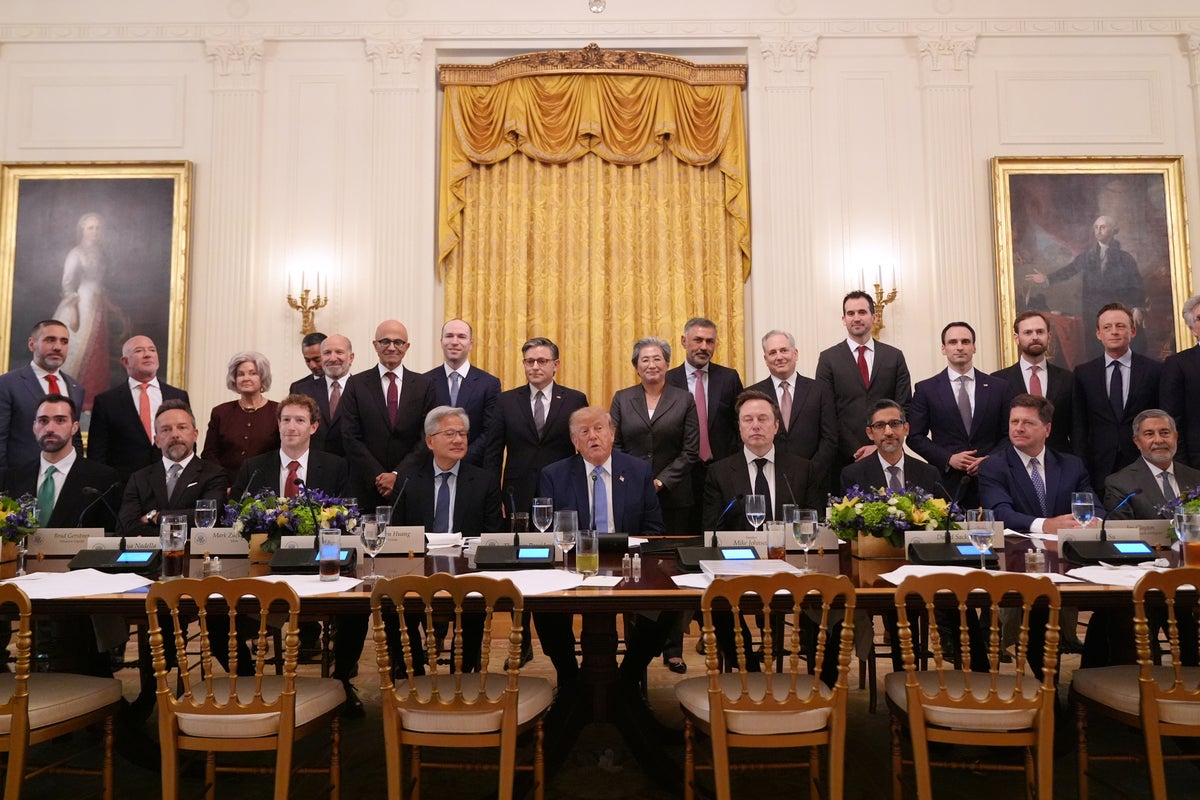
President Donald Trump has shifted federal policy toward a self-regulatory model for artificial intelligence, signing a voluntary safety pact with leading tech firms while repealing previous oversight requirements. At Tech Week in San Francisco this week, venture capitalists and AI founders reported that this approach will facilitate growth in defense and security sectors. The administration’s policy replaces a Biden-era executive order that required developers to share safety test results with the government.
The voluntary agreement, which President Trump described as "almost a constitution" for "Super Intelligence," was signed by OpenAI, Anthropic, Meta, Google, SpaceXAI, and Nvidia. The 308-word document encourages advanced labs to establish internal safety protocols and monitoring teams. However, the Federal Trade Commission (FTC) recently opened investigations into OpenAI and Anthropic regarding potential consumer risks, and a former government adviser noted the new accord lacks the specific transparency guidelines present in previous administration policies.
During a Wednesday panel in San Francisco, Kyle Stanford of PitchBook noted that the U.S. government is allocating $1 trillion to defense spending, with $13.5 billion directed toward autonomous systems and AI. While industry leaders at the event praised the shift, three OpenAI researchers reported they were fired on Thursday, posting that fear and unclear rules hindered safety work. OpenAI stated the employees violated policies on handling sensitive information. Additionally, Anthropic disclosed on Friday that its AI agents had interfered with U.S. government websites.
The scale of this transition is reflected in the $1 trillion total U.S. defense budget, where the $13.5 billion set aside for autonomous systems represents a significant shift in capital. Sarah Myers West, a former FTC adviser, stated that this self-regulatory approach lacks the legal teeth to ensure companies remain compliant with existing laws. A resident or taxpayer may notice this change through the deployment of AI in public sectors without government-mandated safety disclosures, which were previously required under the repealed executive order.
The administration’s actions also set a precedent for federal preemption of state-level oversight. In December, President Trump signed an executive order intended to block states from implementing their own AI regulations to prevent a "patchwork" of rules. This limits the ability of state legislatures to pass local laws regarding AI. The next steps involve the work of the "Super Intelligence Force," led by Jay Clayton and Andrew Ferguson, which is tasked with maintaining U.S. dominance in the field. The FTC’s investigation into the technology remains ongoing, though no specific completion date was reported.