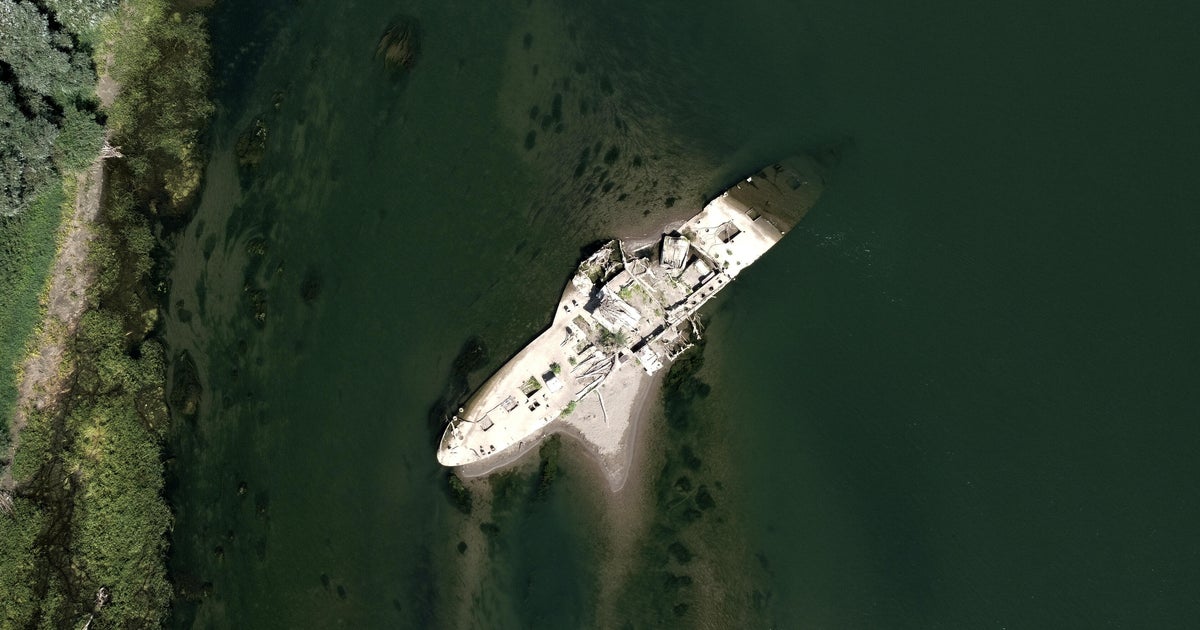
The wreck of a steam tugboat from the early 20th century has surfaced in the Sava River near Sremska Mitrovica, Serbia, as water levels drop during a period of heat and drought across Europe. While the vessel, known as the Slovenian, has been partially visible in the past, local residents and historians reported that the rusting hull has not been this exposed in several years.
According to historian Andrija Popovic, head of the local town museum, the boat was constructed in Budapest in 1913 and originally named the Vag. It measured approximately 177 feet in length and served as a cargo vessel under the Austro-Hungarian Empire. Following World War I, the ship was transferred to the Kingdom of Serbs, Croats and Slovenians as war reparations and renamed the Slovenian. During World War II, the vessel was used by anti-fascist forces to transport equipment and wounded soldiers until it struck a German mine and sank in late April 1945.
The emergence of the Slovenian is part of a broader trend across European waterways as a lack of winter snow and a dry spring have led to receding water levels. In other regions, falling river levels have revealed Nazi German warships in the Danube near the Serbian-Romanian border, the piers of an ancient Roman bridge in Italy's Tiber River, and woolly mammoth remains in Bulgaria. The drought has also impacted modern infrastructure, disrupting traffic on the Danube and affecting nuclear power plant operations in Hungary and Romania.
The scale of the environmental conditions is widespread, with the European Drought Observatory reporting that half of the European Union and the United Kingdom were experiencing drought by late July 2026. Approximately 9% of that territory reached the most severe "alert" level. These conditions have concrete impacts on energy and logistics; low water in the Danube has restricted cooling for nuclear plants and halted commercial shipping, which may influence electricity costs and supply chain reliability for businesses and households relying on these waterways.
Hydrology experts, including Dejan Vladikovic, indicate that such events may become a "new normalcy" as climate change increases the frequency and intensity of extreme dryness. The European Union's Copernicus Climate Change Service notes that Europe has warmed at twice the global average since the 1980s. While historical relics like the Slovenian provide specific data for researchers and historians, the underlying water shortages continue to pressure water supplies and infrastructure. No specific date for a return to normal water levels was reported.