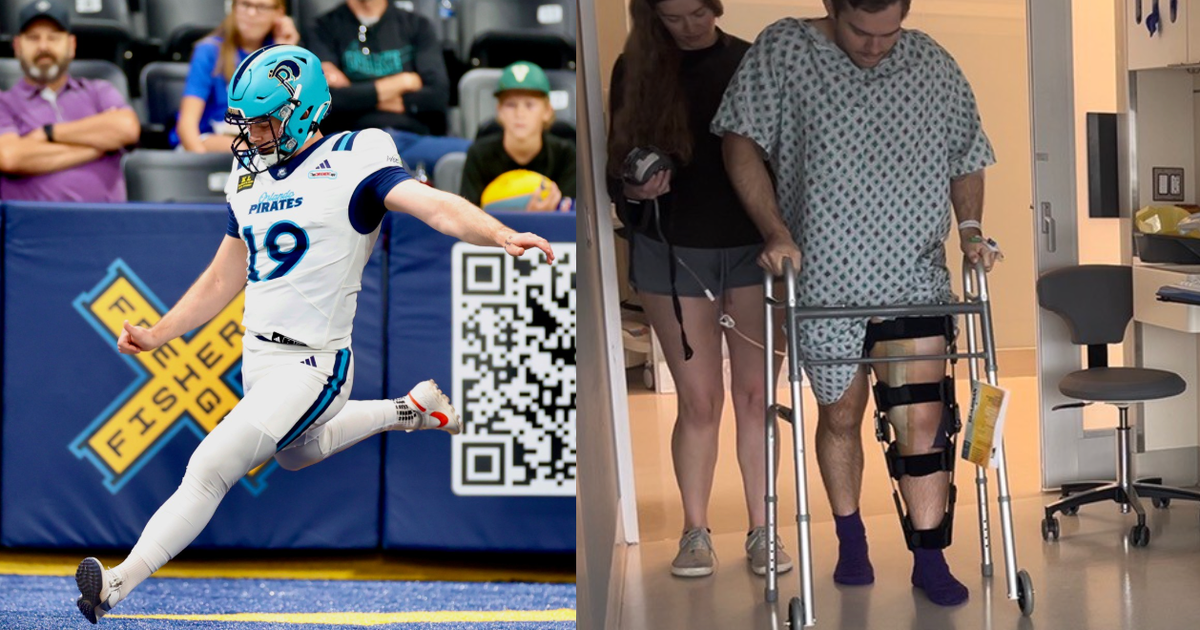
Henry Nell, a 28-year-old professional arena football kicker, returned to the field for a season-opening game in 2026 after undergoing an 11-hour surgery to remove a rare bone cancer from his leg. Doctors originally told Nell that his left leg might require amputation to address parosteal osteosarcoma, a slow-growing tumor located behind his knee. Instead, surgical oncologists at NYU Langone Health performed a limb-preserving procedure that replaced part of his bone with cadaver tissue and metal hardware.
Nell first noticed mobility limitations in his leg while playing in the Canadian Football League, which he initially attributed to athletic wear and tear. After moving to a team in Albany, New York, in 2025, his symptoms worsened, leading a team trainer to recommend an X-ray. The scan revealed a mass that had likely been growing for years. After a local oncologist suggested amputation, Nell sought a second opinion from Dr. Nicola Fabbri, chief of the Division of Musculoskeletal Oncology Surgery at NYU Langone.
The surgery, conducted in July 2025, three weeks after Nell won a league championship, was more invasive than initially hoped. To fully excise the cancer, Dr. Fabbri had to remove Nell's anterior cruciate ligament (ACL) and posterior cruciate ligament (PCL). The area was reconstructed using two metal plates, 12 screws, and cadaver bone. While Dr. Fabbri noted that such a recovery for a professional athlete had not been documented before, Nell was cleared to put weight on the leg six weeks later and began jogging and kicking within three months.
For a person facing a similar diagnosis, this precedent provides a potential return to physical activity. Nell was able to return to professional competition with the Kansas Barrels less than one year after his operation, rather than the year and a half predicted for normal walking. This demonstrates that specialized surgical techniques using cadaver bone and metal reinforcement can maintain structural integrity even when critical ligaments like the ACL and PCL are entirely removed.
The knock-on effects involve future medical protocols for musculoskeletal oncology. Dr. Fabbri stated that Nell’s recovery provides a case study for future patients to show that a return to professional sports is possible after such extensive reconstruction. Nell remains cancer-free as of late 2026, and his medical team reports that the risk of recurrence decreases the longer he remains in remission. He is scheduled to play another season of arena football in the spring of 2027.