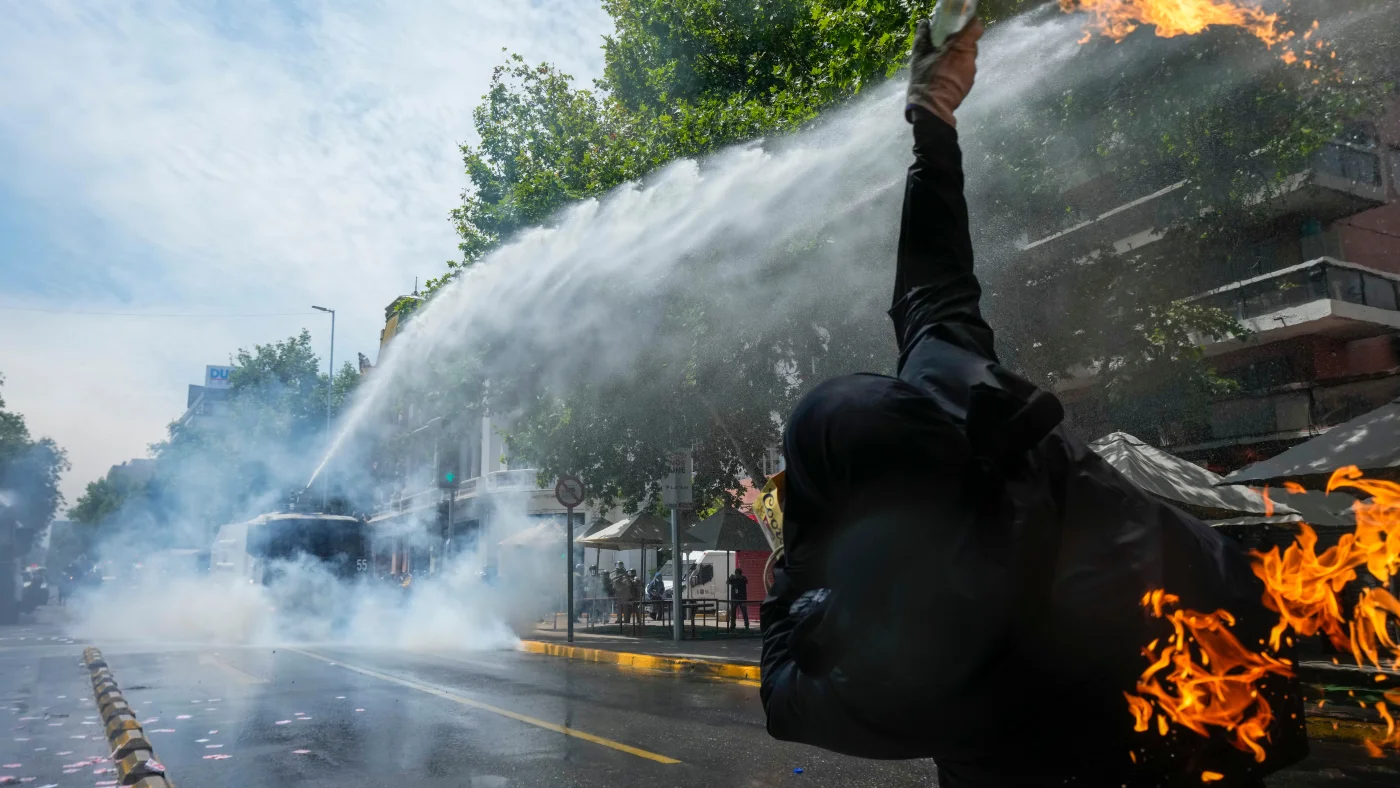
President José Antonio Kast is facing public demonstrations and transport strikes as rising fuel prices and government spending proposals generate friction in Chile. On Friday, November 13, the government responded to a blockade by truckers' unions by sending a bill to Congress intended to reverse planned fuel price increases.
Kast assumed office in December 2025 after a campaign focused on public security and illegal immigration. His administration currently holds a 24% approval rating eight months into his term. The recent unrest follows a July decision by the government to decline the use of an anti-inflation tool that could have mitigated fuel price spikes linked to the conflict between the U.S., Israel, and Iran.
On Friday, November 13, protesters in Santiago demonstrated against various government actions, including proposed budget cuts to education, science, and culture. Public anger was also directed at a recent government decree that reduced the sentences of 56 prisoners convicted of crimes ranging from child rape to dictatorship-era human rights violations. Kast labeled the decree an "error" but maintained support for the undersecretary who signed it.
For the average Chilean household, the impact is felt in the cost of everyday goods and transportation. Protester Simón Echavarría noted that while the cost of living is comparable to European levels, local salaries are roughly 20% of those in Europe. Residents may face further changes to their daily lives if the proposed budget passes, as it seeks to reduce funding for social programs and education. This follows a period where students had previously secured free education through prior years of activism, a benefit Patricia Pereira, a 30-year-old veterinarian, stated is now being questioned.
The situation in Chile mirrors broader regional trends where leaders aligned with U.S. President Donald Trump face pressure over inflation. In Argentina, 60% of the public disapproves of President Javier Milei, while 53% of Peruvians disapprove of President Keiko Fujimori's government. The next immediate step for Chile is the congressional vote on the fuel price bill, which is expected to be approved this month. However, the administration's broader budget proposal remains under debate in Congress.