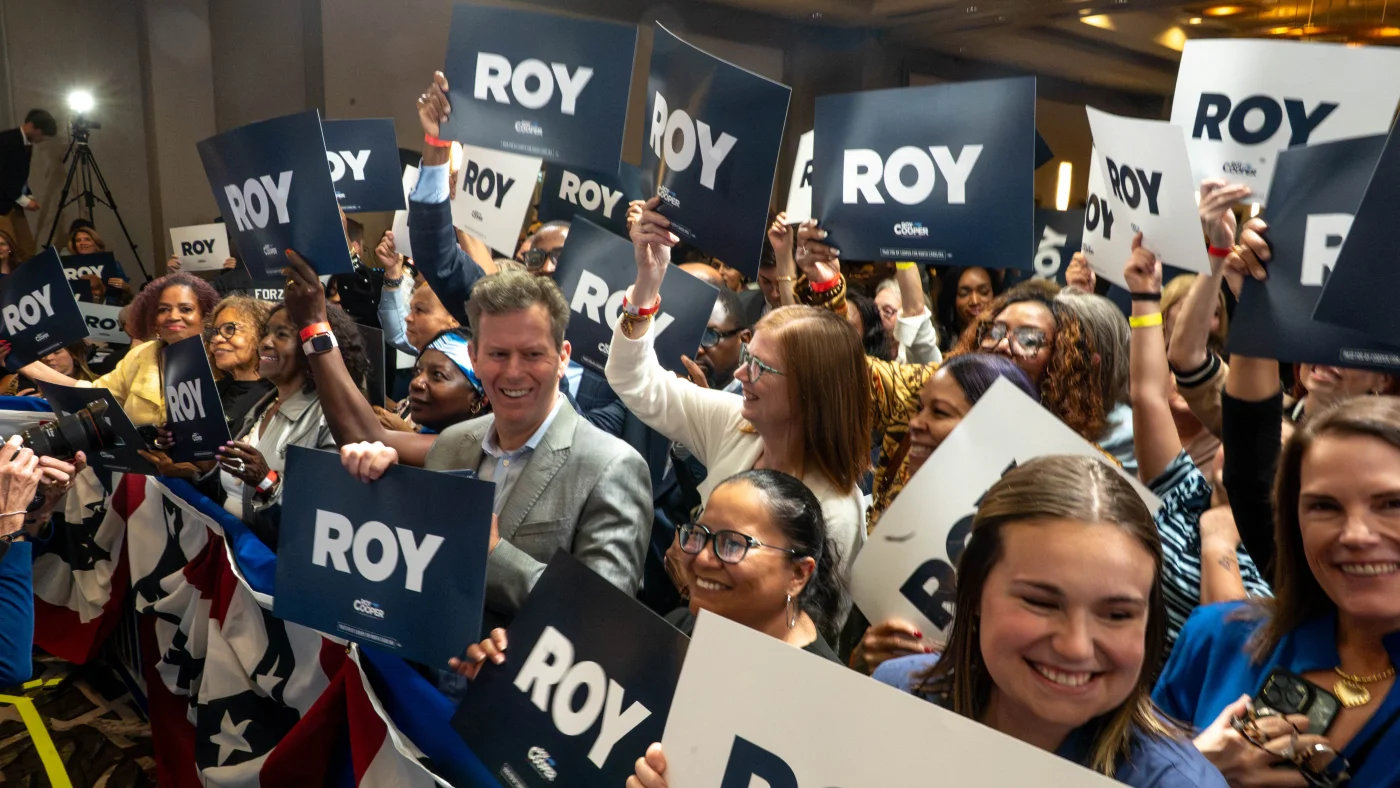
The Associated Press has called five U.S. House races in North Carolina for Democrats, including four seats previously held by Republicans. These results occurred in districts that were redrawn in 2023 with the intent of favoring Republican candidates. As of Thursday, Democrats had secured nine of the state's 14 congressional seats, a shift from the previous delegation which consisted of 10 Republicans and four Democrats.
The 2023 redistricting process altered several boundaries to improve Republican electoral prospects. In the 2024 elections, these districts performed as expected; for example, Republican Rep. Addison McDowell won the 6th District by more than 38% that year. However, in the November 3, 2026, election, Democratic candidates won several of these areas, coinciding with a win by Democrat Roy Cooper in the state's open U.S. Senate race.
Specific flips included High Point Mayor Cyril Jefferson defeating incumbent Rep. Addison McDowell (R) in the 6th District and former West Virginia State Senator Richard Ojeda defeating National Republican Congressional Committee (NRCC) Chairman Rep. Richard Hudson (R) in the 9th District. In the 13th District, Paul Barringer defeated Rep. Brad Knott (R), while LaKesha Womack defeated Rep. Tim Moore (R), the former speaker of the N.C. House, in the 14th District. Additionally, incumbent Rep. Don Davis (D) retained the 1st District, leading Laurie Buckhout (R) by more than 10,000 votes despite legislative efforts to redraw the district in favor of the GOP.
For residents in these districts, the change means their interests in Congress will be managed by a different political party starting in the next legislative session. This could lead to different priorities regarding federal funding, constituent services, and legislative votes on national policy. The shift is particularly notable for residents of the 1st District, where map changes intended to make the seat more competitive for Republicans did not prevent the Democratic incumbent from increasing his margin of victory compared to 2024. In the 5th District, the race is so close that 11-term incumbent Virginia Foxx (R) trails by only 99 votes, meaning a very small number of households will determine the final outcome.
The knock-on effects include a leadership vacuum at the NRCC and a potential shift in how national parties allocate resources to North Carolina in future cycles. Rep. Brian Jack (R-GA) suggested in a letter to colleagues that a lack of support from Senate Republicans may have contributed to the losses. As of Thursday, five races remained uncalled. Two of these, the 3rd and 5th districts, are separated by fewer than 250 votes each and are likely headed for recounts. Official results and potential recounts will determine the final balance of the delegation in the coming weeks.