The Plain Record

Neutral daily news — clear headlines, complete facts.

National

Democrats Gain Control of Multiple State Legislatures Following Election Results

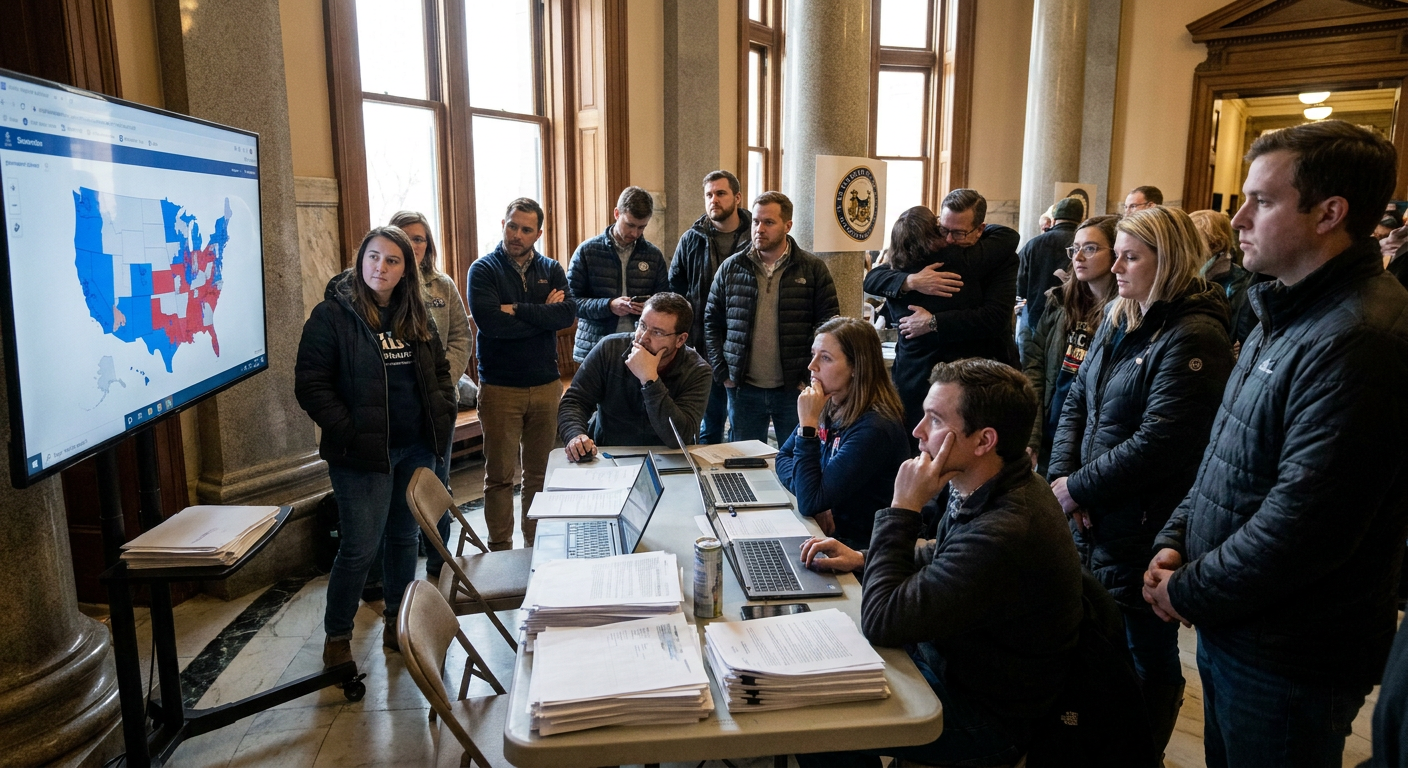
Democrats gained control of several state legislatures, establishing new trifectas in Arizona and other states while ending Republican supermajorities in North Carolina.

Background: The Electoral College, explained: how the United States actually elects a president

Published November 8, 2026 at 8:12 PM EST

The short answer

Democrats gained control of several state legislatures, establishing new trifectas in Arizona and other states while ending Republican supermajorities in North Carolina. Democratic candidates won control of several state legislatures following recent elections, shifting the balance of power in previously Republican-led states. In Arizona, Democrats secured a "trifecta"—control of the House, Senate, and governor's office—for the first time since 1966.

Democrats Gain Control of Multiple State Legislatures Following Election Results

The Facts

Who
Gov. Katie Hobbs (D-AZ), Gov. Josh Stein (D-NC), Sen. John Kavanagh (R-AZ)
What
Democratic legislative gains in state houses across the U.S.
When
November 8, 2026
Where
United States, with focus on Arizona and North Carolina
Why
The shift in legislative control allows Democrats to pursue agendas regarding Medicaid expansion, minimum wage increases, and school voucher reform.

Democratic candidates won control of several state legislatures following recent elections, shifting the balance of power in previously Republican-led states. In Arizona, Democrats secured a "trifecta"—control of the House, Senate, and governor's office—for the first time since 1966. In North Carolina, Democrats flipped the state House and are awaiting final results in the Senate to determine if the chamber will be tied or held by a one-seat Republican majority.

Prior to these elections, Republicans controlled 28 state legislatures compared to 18 for Democrats. According to the National Conference of State Legislatures, Democrats are now projected to control 25 legislatures, while Republicans will hold 21. In North Carolina, Republican supermajorities previously used their voting power to override vetoes from Democratic governors, passing measures such as abortion restrictions, private school voucher expansions, and new congressional maps.

In Arizona, Democratic Governor Katie Hobbs, who won reelection, had previously set a state record with more than 500 vetoes against Republican legislative proposals. With new Democratic majorities, Hobbs intends to pursue funding for rent and utility assistance, childcare subsidies, and support for first-time homebuyers. In North Carolina, Governor Josh Stein (D) has called for bipartisan cooperation on affordability issues, while legislative Democrats have discussed rolling back abortion restrictions and raising the minimum wage.

The scale of this shift is reflected in the National Conference of State Legislatures' projection that Democrats now control 25 state legislatures, up from 18. This includes new Democratic trifectas in Arizona, Pennsylvania, Michigan, Wisconsin, Minnesota, and Nevada. In states like Texas and Georgia, Democrats flipped a single chamber. For residents in states that have not yet expanded Medicaid, the new legislative balance could lead to expanded health care access.

These changes also signal potential changes to education funding. In Arizona, Democrats plan to restrict the state's school voucher program, known as Empowerment Scholarship Accounts (ESAs), following reports of public funds being spent on non-educational items. Republican State Senator John Kavanagh acknowledged that voters wanted reform in this area. While Democrats move to implement these agendas, the Republican State Leadership Committee has stated it intends to focus on retaking these seats in two years. The final composition of the North Carolina Senate remains dependent on a final vote count, which will determine if the Democratic lieutenant governor will serve as a tie-breaker.

Timeline of what happened

Key dates and decisions, in the order they occurred.

  1. 1966

    Arizona Democrats last held a government trifecta

  2. 2010

    Republicans won dominant control of state elections

Summaries are written by The Plain Record to state the facts of a story plainly and without political slant. Drafted with AI assistance and checked against the source record before publication. See how we report, or report a correction.

← Back to the front page

Questions readers ask

What happened: Democrats Gain Control of Multiple State Legislatures Following Election Results?

Democratic candidates won control of several state legislatures following recent elections, shifting the balance of power in previously Republican-led states. In Arizona, Democrats secured a "trifecta"—control of the House, Senate, and governor's office—for the first time since 1966.

Who is involved?

Gov. Katie Hobbs (D-AZ), Gov. Josh Stein (D-NC), Sen. John Kavanagh (R-AZ)

When did this happen?

November 8, 2026

Where did this happen?

United States, with focus on Arizona and North Carolina

Why does this matter?

The shift in legislative control allows Democrats to pursue agendas regarding Medicaid expansion, minimum wage increases, and school voucher reform.