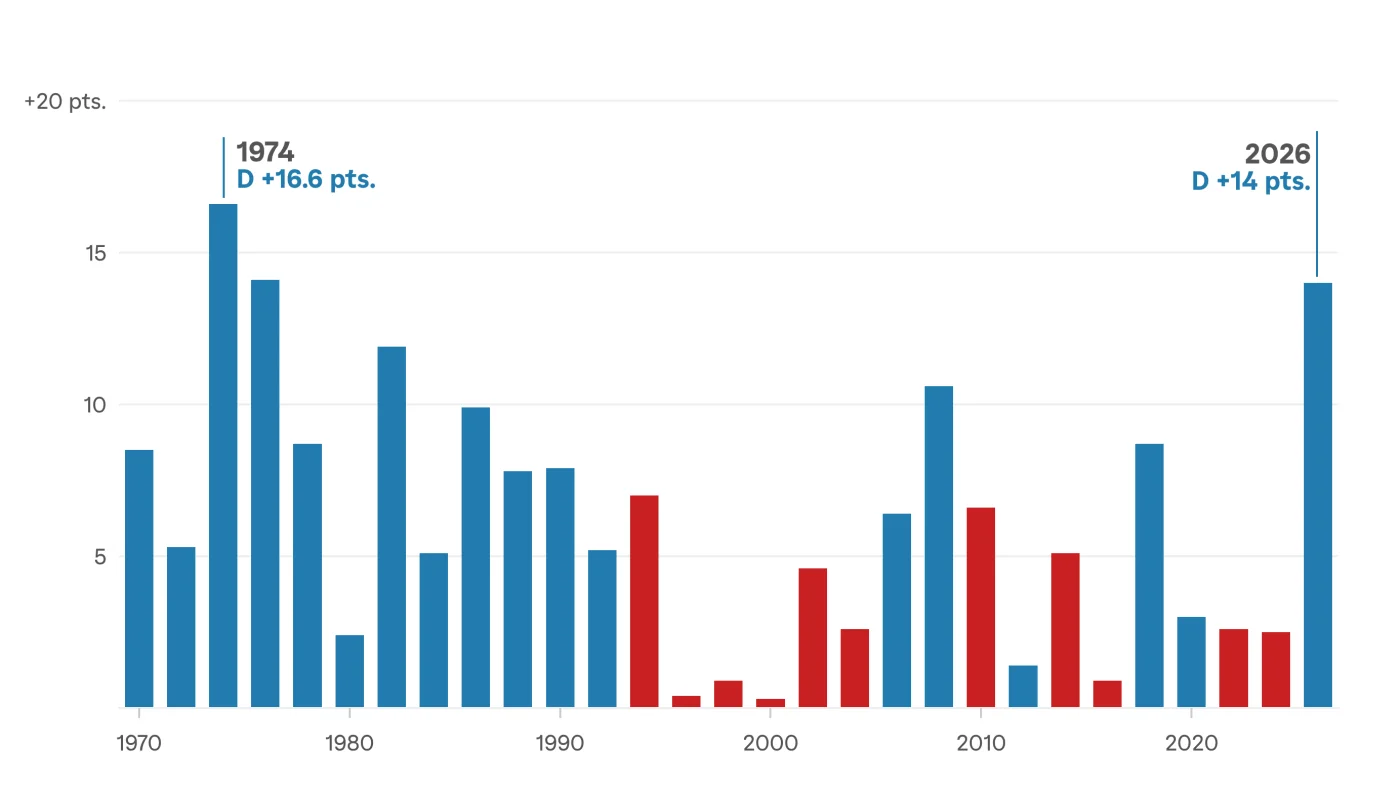
Vote counts for the 2026 midterm elections indicate that Democrats secured 56% of the national vote for House of Representatives races, while Republicans received 42%. According to data reported by NPR, this 14-point margin represents the largest popular vote spread for either party in a House election in 50 years, surpassing margins seen following the Watergate scandal.
The results follow a period characterized by frequent shifts in congressional power. Starting in January, control of the House will have changed hands five times in the last 20 years, a frequency not seen since the post-Reconstruction era following the Civil War. Prior to this, Democrats held the House majority for 40 consecutive years until the 1994 election.
As of the latest tallies, Democrats have flipped 46 seats currently held by Republicans. This total may reach 49 seats as three additional races where Democrats hold the lead remain uncalled. This represents the second-highest number of flipped seats this century, following the 2010 midterms when Republicans flipped 66 seats.
If Democrats maintain their leads in the remaining uncalled contests, they will hold 260 seats in the chamber. This would be the largest House majority for any party since the 102nd Congress, which lasted from 1991 to 1993. The margin exceeds the House ballot spreads seen in 2006, 2010, and 2018, as well as the almost 11-point margin recorded during the 2008 election.
The scale of the Democratic majority, potentially reaching 260 seats, changes the day-to-day legislative environment by providing a wider buffer for the majority party to pass legislation without requiring unanimous support from its own members or bipartisan cooperation. This contrasts with the narrower majorities seen earlier this century. Residents in the flipped districts will notice a change in their representative’s party affiliation and voting priorities in the House. The source notes that the current Republican seat count returns the party to a position similar to its standing before the 1994 "Contract with America" era.
The effects include a shift in the leadership of all House committees and the election of a new Speaker of the House. The results also establish a new historical benchmark for midterm margins, exceeding the "thumping" described by George W. Bush in 2006 and the "shellacking" described by Barack Obama in 2010. What happens next is the final certification of the three remaining House races and the official seating of the new Congress in January, which will mark the fifth time the chamber has changed hands in two decades.