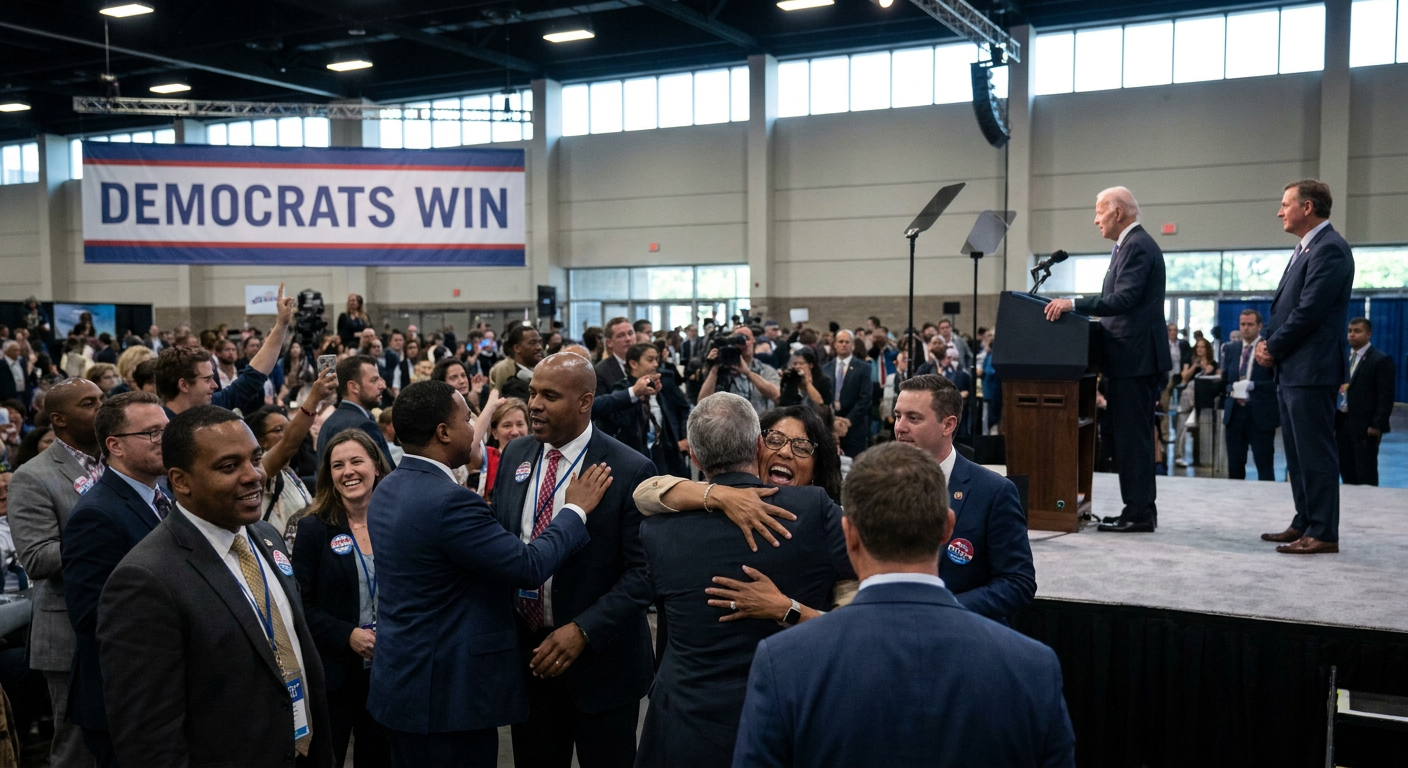
Democratic candidates secured majorities in both the U.S. House of Representatives and the U.S. Senate following recent midterm elections. NPR reported that the shift in power is the largest since 1974, with Democrats winning several key races in historically Republican-leaning states. In the Senate, Democrats currently hold 54 seats, with contests in Mississippi and Alaska yet to be called. In the House, more than a dozen races remain undecided, though Democrats are projected to hold as large as an 80-seat majority.
The election results included several notable individual victories. Keisha Lance Bottoms won the Georgia gubernatorial race, becoming the first Black female governor in U.S. history. In Michigan, Abdul El-Sayed was elected to the Senate, and in Texas, James Talarico won his Senate race. Democrats also gained control of both legislative chambers and the governor's mansions in Arizona, Michigan, Minnesota, Nevada, Pennsylvania, and Wisconsin. Following the results, Sen. Ted Cruz (R-TX) described the outcome as a "Watergate-level repudiation," while Gov. Ron DeSantis (R-FL) characterized it as close to an "extinction-level event" for the Republican party.
Rep. Hakeem Jeffries (D-NY), who is expected to become the next Speaker of the House, stated that the Democratic caucus will focus on "affordability" and "accountability." The legislative agenda includes bills intended to lower prices for housing, healthcare, food, and gasoline. Additionally, the caucus plans to launch investigations into the relationship between high prices and corruption. President Donald Trump responded to the shift by stating he is willing to negotiate with Democrats but will use his veto power if agreements cannot be reached.
President Trump also appointed Stephen Miller as his new Chief of Staff. Miller, who currently serves as deputy chief of staff, has promoted hard lines on issues including mass deportations and believes in unchecked executive power. The appointment is seen by analysts as a signal that the administration is prepared for confrontation with the incoming Congress. While the Democratic Socialists of America doubled their House presence from four to eight seats, analysts noted that centrist Democrats winning in rural and Republican-leaning areas were the primary drivers of the party's new majority.
The scale of this shift is reflected in the loss of six state "trifectas" by Republicans, now controlled by Democrats in states including Arizona, Pennsylvania, and Michigan. This means a single party now controls the legislative and executive branches in those states, which influences local tax rates, education funding, and voting laws. Additionally, the high turnout among Black and Latino voters, who shifted back toward the Democratic party after moving toward Trump in 2024, indicates a change in the voting behavior of millions of citizens who cited concerns over the economy and the Supreme Court’s weakening of the Voting Rights Act.
The appointment of Stephen Miller as Chief of Staff establishes a tone for the executive branch’s interactions with the new legislative majorities. Because Democrats do not require the support of a small group to pass House bills—unlike the previous three-seat Republican majority—the legislative process may be more streamlined within the chamber. However, the next steps involve the formal seating of the new Congress in January 2027, where the final seat counts for the House and the remaining Senate races in Alaska and Mississippi will be officially determined. Dates for specific investigative hearings or votes on affordability legislation have not yet been announced.