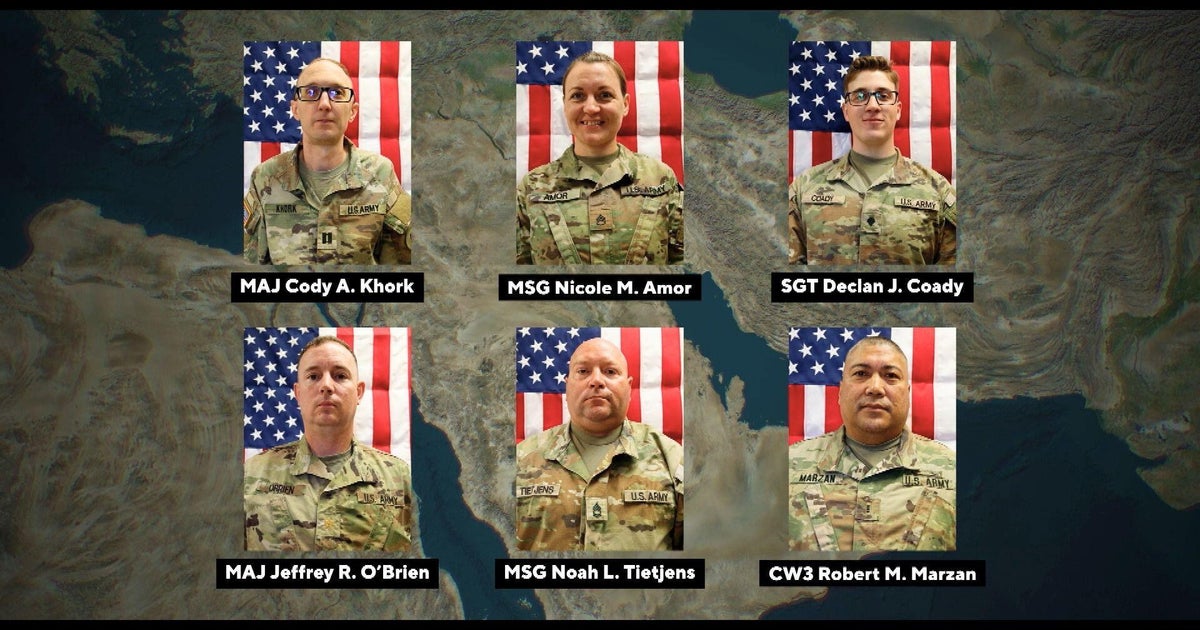
Family members of U.S. soldiers killed in a drone strike in Kuwait are seeking information regarding military leadership decisions prior to the attack. The U.S. Army recently completed an investigation into the strike, which occurred during the first 24 hours of a war with Iran, and began briefing the affected families on the findings this month.
The strike targeted a tactical operations center at Port Shuaiba, a small Army outpost located approximately 65 miles from Iran. Six Americans, including Master Sgt. Nicole Amor, Chief Warrant Officer Robert Marzan, and Sgt. 1st Class Noah Tietjens, were killed when an Iranian drone hit the facility. At the time of the attack, the Pentagon had moved 90% of its ground forces out of Kuwait to avoid retaliatory strikes, but roughly 70 members of the Army Reserve’s 103rd Sustainment Command remained at the outpost to handle logistics.
Maj. Stephen Ramsbottom, the 103rd’s deputy chief of operations, stated that the facility lacked defenses against aerial attacks, having only been equipped to stop ground-level threats like car bombs. Ramsbottom reported that he and others raised concerns about drone vulnerability to Brig. Gen. Clint Barnes and Maj. Gen. John Hinson, who oversaw logistics for U.S. Central Command. Ramsbottom alleged that Maj. Gen. Hinson dismissed these concerns, stating they did not have to worry about protection. Neither general responded to requests for comment.
Additional details from survivors and family members suggest the site was under-resourced. Maj. Ramsbottom filed a whistleblower complaint to Congress, alleging the outpost lacked a physician, a fixed aid station, and had only one ambulance. Joey Amor, the husband of Master Sgt. Amor, stated that surviving soldiers had to use internet search engines to locate local Kuwaiti hospitals after the strike. While Secretary of Defense Pete Hegseth stated on March 2 that the troops were well-protected and that the drone was an outlier that hit a fortified center, Maj. Ramsbottom said a requested counter-drone system never arrived.
The scale of the incident involves the first six American combat deaths of the Iran conflict and an eight-month-long military investigation. For the soldiers involved, the lack of medical infrastructure—described by Maj. Ramsbottom as a single ambulance and no on-site physician for 70 people—meant that injured personnel faced delays in emergency care, with survivors resorting to using civilian mobile devices to find hospitals. This lack of preparation in a target zone creates a precedent for how the military balances troop withdrawal with the protection of remaining logistical units.
The knock-on effects include a congressional whistleblower inquiry initiated by a high-ranking officer within the unit, which may force a review of how the Pentagon allocates counter-drone defense systems. If the investigation confirms that intelligence warned of the specific target list, it could lead to changes in how U.S. Central Command evaluates force protection requirements for logistics hubs. The Army completed its internal investigation in June, and briefings for the Gold Star families are scheduled to conclude this week.