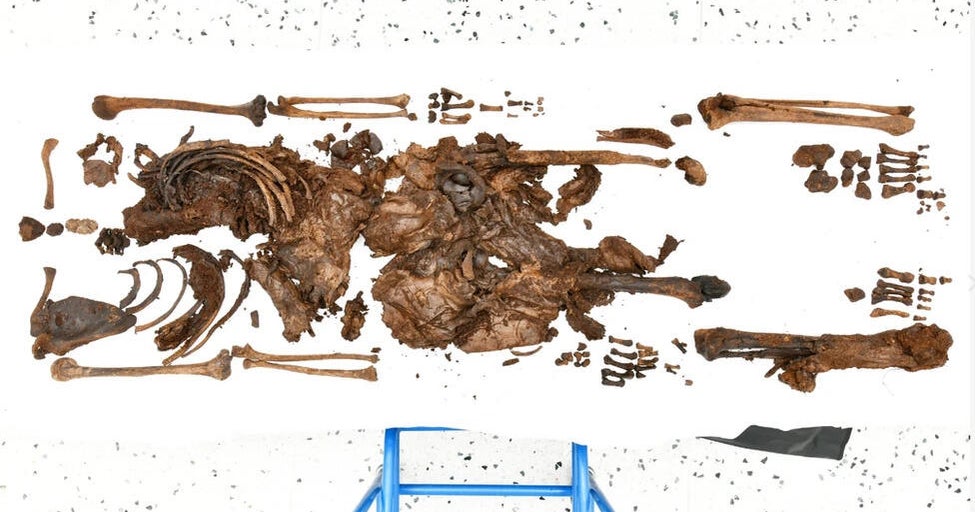
A public investigation modeled on a modern coroner’s inquest has determined that a young woman whose remains were discovered in a Northern Ireland peat bog was beheaded approximately 2,000 years ago. Researchers from the Ulster Museum stated that the individual, known as the "Ballymacombs More Woman," was between 15 and 22 years old at the time of her death during the prehistoric Iron Age.
The remains were first discovered in October 2023 in a bog located in central Northern Ireland. Since the discovery, a team of specialists has used scientific mapping, 3D imaging, and laboratory analysis of bone, hair, skin, and nails to reconstruct the circumstances of her life and death. Carbon dating placed the remains between 343 B.C. and 1 B.C.
Archaeologists reported finding distinct cut marks on the woman's neck, indicating she was decapitated from behind with a bladed weapon. Niamh Baker, curator of archaeology at the Ulster Museum, noted that no skull was recovered during the investigation. Baker stated that the evidence suggests the woman was "intentionally decapitated" and may have been part of a broader European Iron Age tradition of ritualized killing or sacrifice.
For the residents of the nearby town of Bellaghy, the scale of the impact is social and communal. Members of the local historical society, who have named the woman Aine, attended the inquest to act as "advocates" for the deceased. The investigation changes how the local community engages with its prehistoric landscape, transforming a scientific specimen into a recognized former resident with a documented biography. Researchers believe the findings could set a precedent for how other bog bodies—human remains naturally preserved in peat—are analyzed and presented to the public using modern forensic techniques.
The investigation into the woman's status continues, as researchers consider whether her death was related to "kingship and sovereignty" or "agricultural or weather" issues of the period. While the coroner-style event has concluded, the Ulster Museum and National Museums NI will continue to research the remains to further clarify her role in Iron Age society. No specific dates for future exhibitions or follow-up reports were provided in the investigation summary.