The Plain Record

Neutral daily news — clear headlines, complete facts.

National

Kim Jong Un Orders Increase in Nuclear Production Following Trump Asia Visit

Kim Jong Un inspected nuclear production sites and called for an expanded arsenal following President Trump's recent Asia visit.

Background: The Electoral College, explained: how the United States actually elects a president

Published November 27, 2026 at 2:05 AM EST

The short answer

Kim Jong Un inspected nuclear production sites and called for an expanded arsenal following President Trump's recent Asia visit. North Korean leader Kim Jong Un inspected nuclear material production facilities and called for an increase in the country's nuclear arsenal, according to reports from the state-run Korean Central News Agency (KCNA) on Thursday.

Kim Jong Un Orders Increase in Nuclear Production Following Trump Asia Visit

The Facts

Who
North Korean leader Kim Jong Un, President Donald Trump, and South Korean defense officials.
What
Kim Jong Un visited nuclear material production facilities and called for an increase in nuclear weapon production, citing threats from the U.S. and South Korea.
When
Wednesday, November 25, 2026, and Thursday, November 26, 2026
Where
Undisclosed locations in North Korea, including a nuclear research institute and production factories.
Why
Kim stated the expansion is necessary to counter nuclear threats from the U.S. and its allies; analysts suggest it is a signal that North Korea will not discuss denuclearization.

North Korean leader Kim Jong Un inspected nuclear material production facilities and called for an increase in the country's nuclear arsenal, according to reports from the state-run Korean Central News Agency (KCNA) on Thursday. The visits occurred shortly after President Donald Trump concluded a trip to Asia, during which he expressed interest in meeting with Kim. Kim stated the expansion is necessary to address security threats he attributed to the United States and South Korea.

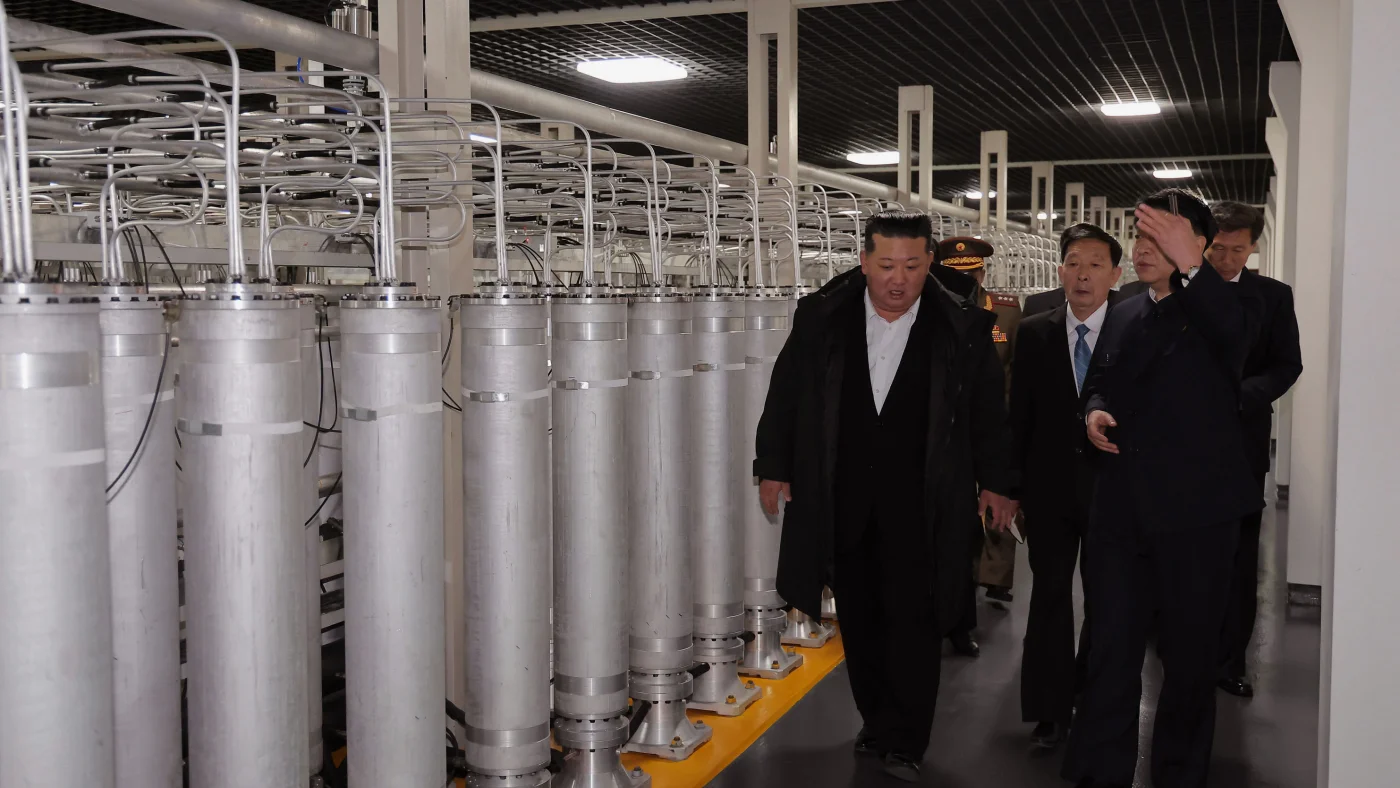
The inspections took place at several locations on Wednesday, November 25, 2026, including a newly inaugurated nuclear materials factory, an expanding facility, a nuclear-powered equipment production base, and a nuclear research institute. The specific locations of these sites were not disclosed, though outside experts suggested a facility disclosed in June may be an additional uranium enrichment facility at the Yongbyon nuclear complex. Photographs released by KCNA showed Kim observing centrifuges and what appeared to be nuclear warheads.

Kim characterized the growth of the nuclear program as an "irreversible reality" intended to counter U.S. regional activities, such as the potential for allies to possess nuclear-powered submarines. He specifically emphasized the "urgent" need for low-yield battlefield nuclear weapons due to tensions at the border with South Korea. Moon Seong Mook, an analyst at the Korea Research Institute for National Strategy, stated that these actions are likely intended to signal that North Korea will not accept denuclearization as a condition for future diplomatic talks.

For residents in the region, the concrete change involves a heightened state of military readiness. South Korea’s Defense Ministry stated it is taking the comments regarding battlefield nuclear weapons seriously and is maintaining its defensive alliance with the U.S. While President Trump told the New York Post that he believes he can revive diplomacy through letter-writing, a person living in the region would see no immediate reduction in military posturing or international sanctions, which Kim seeks to have lifted in exchange for recognition as a nuclear state.

The knock-on effects include increased pressure on international non-proliferation standards and the potential for a renewed arms race in East Asia. The precedent established here is a public rejection of denuclearization as a baseline for U.S.-North Korea relations. What happens next depends on the upcoming year-end Workers' Party conference, where North Korea is expected to set its formal military goals for the coming year. No specific date for the conference or any future meetings between U.S. and North Korean officials has been set.

Timeline of what happened

Key dates and decisions, in the order they occurred.

  1. 2010

    North Korea shows main Yongbyon nuclear complex to U.S. scholars

  2. November 25, 2026

    Kim Jong Un inspects nuclear materials production facilities

  3. November 26, 2026

    KCNA reports on Kim's nuclear facility inspections and comments

Summaries are written by The Plain Record to state the facts of a story plainly and without political slant. Drafted with AI assistance and checked against the source record before publication. See how we report, or report a correction.

← Back to the front page

Questions readers ask

What happened: Kim Jong Un Orders Increase in Nuclear Production Following Trump Asia Visit?

Kim Jong Un visited nuclear material production facilities and called for an increase in nuclear weapon production, citing threats from the U.S. and South Korea.

Who is involved?

North Korean leader Kim Jong Un, President Donald Trump, and South Korean defense officials.

When did this happen?

Wednesday, November 25, 2026, and Thursday, November 26, 2026

Where did this happen?

Undisclosed locations in North Korea, including a nuclear research institute and production factories.

Why does this matter?

Kim stated the expansion is necessary to counter nuclear threats from the U.S. and its allies; analysts suggest it is a signal that North Korea will not discuss denuclearization.