The Plain Record

Neutral daily news — clear headlines, complete facts.

National

Maryland Schools Serve Invasive Blue Catfish to Address Chesapeake Bay Population Growth

School districts in Maryland and Virginia are serving invasive blue catfish to students as part of a regional effort to manage the predator's population.

Published October 27, 2026 at 2:51 AM EDT

The short answer

School districts in Maryland and Virginia are serving invasive blue catfish to students as part of a regional effort to manage the predator's population. Public schools in Maryland and Virginia have begun serving invasive blue catfish in cafeterias to help control the species' population in the Chesapeake Bay.

Maryland Schools Serve Invasive Blue Catfish to Address Chesapeake Bay Population Growth

The Facts

Who
Beth Brewster (Caroline County Public Schools), Branson Williams (Maryland Department of Natural Resources), and local watermen.
What
Maryland and Virginia school districts are serving invasive blue catfish in cafeterias to help control the species' population and protect native Chesapeake Bay species like blue crabs.
When
Monday, October 26, 2026, and ongoing monthly meal cycles
Where
Maryland and Virginia, specifically schools near the Chesapeake Bay tributaries and the lower Potomac River.
Why
Blue catfish are an invasive apex predator that now make up 70% of fish biomass in some areas, threatening the native seafood industry.

Public schools in Maryland and Virginia have begun serving invasive blue catfish in cafeterias to help control the species' population in the Chesapeake Bay. School districts, including Caroline County Public Schools in Maryland, are using the fish to create "catty patties"—a breaded fish cake similar to a crab cake—to meet federal dietary requirements and appeal to students.

Blue catfish were introduced to Virginia rivers in the 1970s for recreational fishing. While they were expected to remain in freshwater areas, record rainfall in 2018 lowered salinity levels in the Chesapeake Bay, allowing the fish to spread into every tidal tributary in Maryland. The species has since become an apex predator, with some individuals weighing over 100 pounds.

Biologists with the Maryland Department of Natural Resources report that blue catfish now account for approximately 70% of the fish biomass in certain areas. The fish prey on native species, including blue crabs, menhaden, and rockfish. To manage the population, Maryland officials are encouraging increased human consumption, as the species currently lacks other major predators in the region.

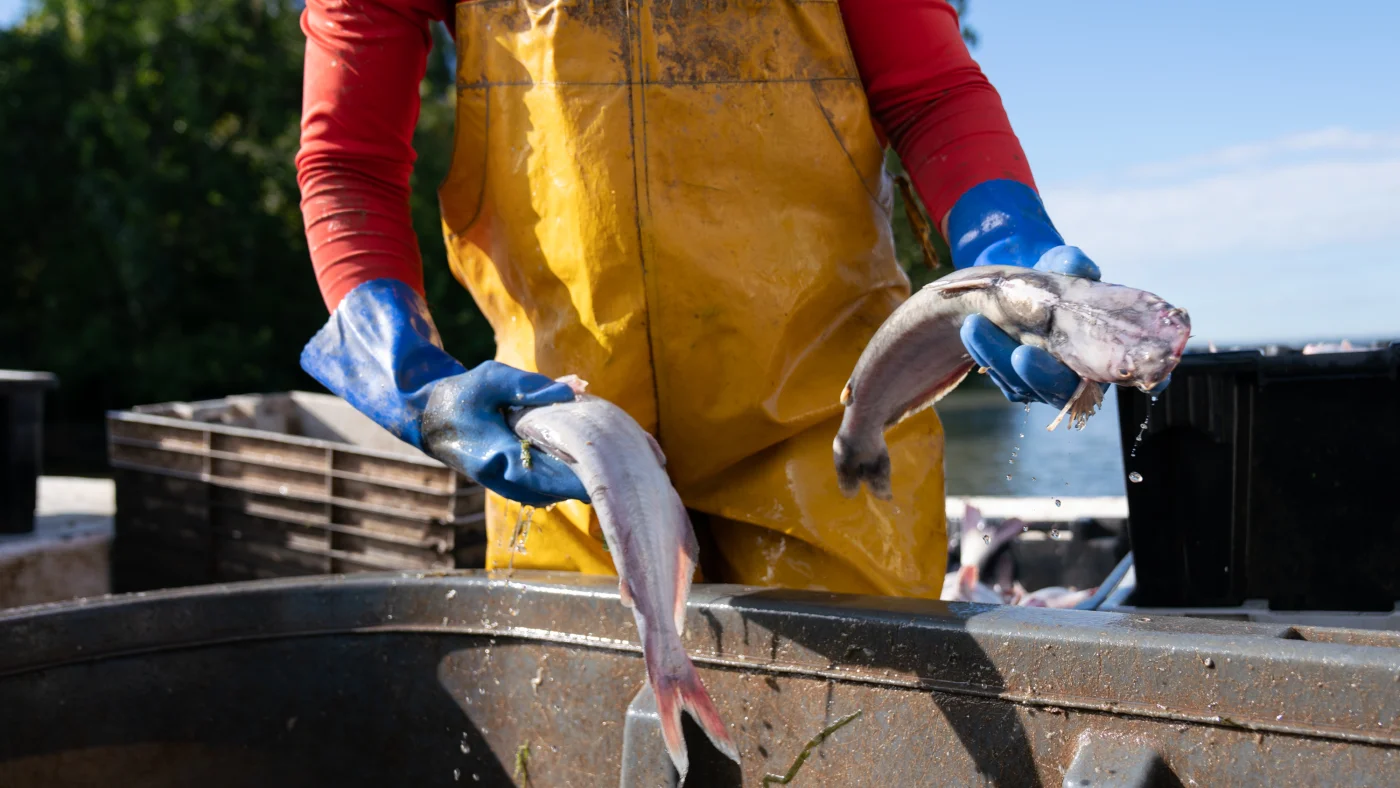
Commercial watermen, such as Rocky Rice on the lower Potomac River, have shifted their primary operations from crabbing to catfish harvesting. Because the fish is classified as invasive, there are no seasonal limits or size restrictions on catches. However, processing remains a bottleneck; federal law requires catfish to undergo U.S. Department of Agriculture (USDA) inspections, and currently only four processors in Maryland are equipped to meet these requirements.

For school districts and food banks, the initiative provides a source of affordable protein. According to Jenn Lovewell of the program Bay2Tray, the fish is being shipped to institutions as far away as Texas. In the school system, students in Maryland and Virginia see these fish served roughly twice a month. While the cost per meal was not specified, officials described it as a sustainable and cost-effective alternative to other proteins that helps meet USDA standards.

Because blue catfish reproduce rapidly, experts like Beth Brewster and Jenn Lovewell state that millions of pounds must be harvested annually just to maintain current population levels. Eradication is considered unlikely. The Maryland Department of Natural Resources continues to encourage the public to keep all blue catfish caught, regardless of size. Processing capacity remains limited to four sites in Maryland, and any expansion of the program will depend on more facilities obtaining USDA inspection certifications.

Timeline of what happened

Key dates and decisions, in the order they occurred.

  1. 1970

    Blue catfish introduced to Virginia rivers for recreational fishing

  2. 2018

    Record rainfall allows blue catfish to spread to all Maryland tidal tributaries

  3. October 26, 2026

    Preston Elementary School serves catfish sandwiches to students

Summaries are written by The Plain Record to state the facts of a story plainly and without political slant. Drafted with AI assistance and checked against the source record before publication. See how we report, or report a correction.

← Back to the front page

Questions readers ask

What happened: Maryland Schools Serve Invasive Blue Catfish to Address Chesapeake Bay Population Growth?

Maryland and Virginia school districts are serving invasive blue catfish in cafeterias to help control the species' population and protect native Chesapeake Bay species like blue crabs.

Who is involved?

Beth Brewster (Caroline County Public Schools), Branson Williams (Maryland Department of Natural Resources), and local watermen.

When did this happen?

Monday, October 26, 2026, and ongoing monthly meal cycles

Where did this happen?

Maryland and Virginia, specifically schools near the Chesapeake Bay tributaries and the lower Potomac River.

Why does this matter?

Blue catfish are an invasive apex predator that now make up 70% of fish biomass in some areas, threatening the native seafood industry.