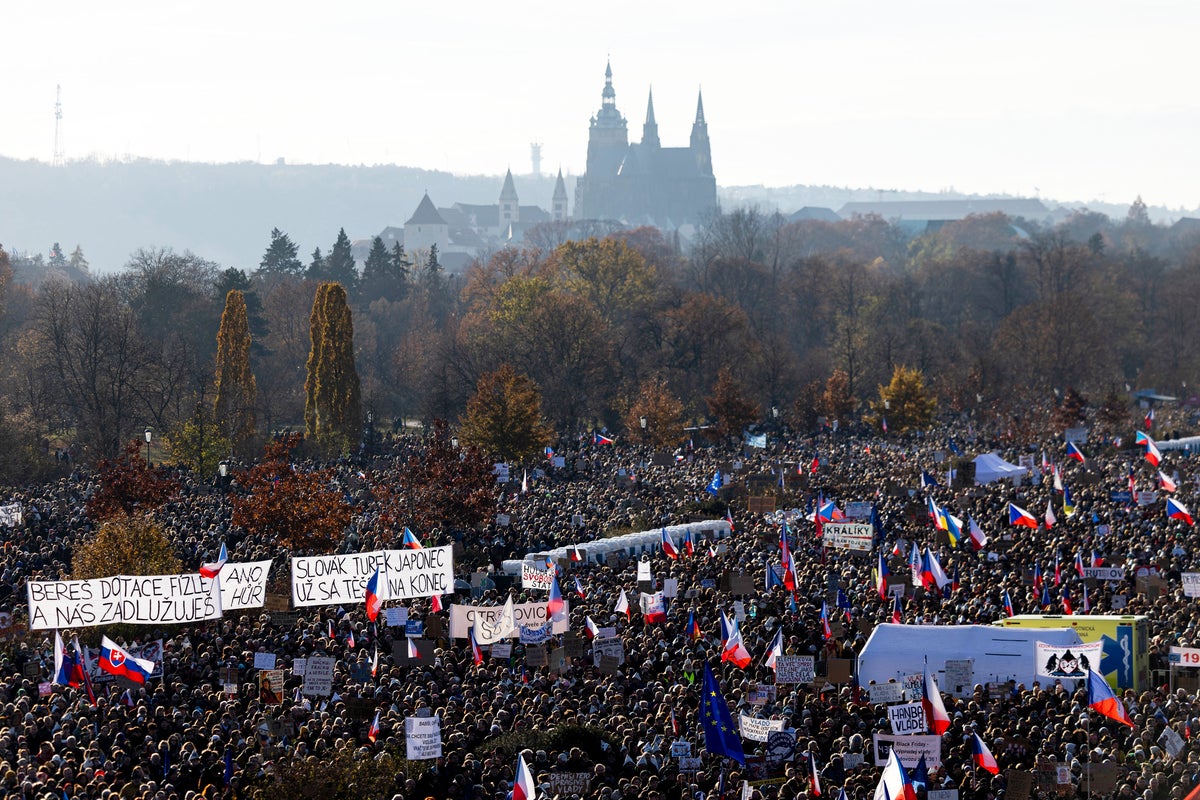
Hundreds of thousands of people gathered in Prague’s Letná Park on Sunday, November 15, 2026, to protest a government plan to change the funding model for Czech public broadcasters. Organizers from the group Million Moments for Democracy estimated the crowd at 350,000 people. The demonstration occurred two days before the anniversary of the 1989 Velvet Revolution protests that ended communist rule.
The proposed legislation would replace the current system of individual and business fees with funding directly from the state budget. The government of Prime Minister Andrej Babiš, whose ANO movement formed a coalition with the Freedom and Direct Democracy party and the Motorists for Themselves party after winning elections last year, moved the bill through its first parliamentary reading on October 24. During that session, lawmakers limited opposition speaking time and held a vote at 4:36 a.m.
Under the new plan, public radio and television broadcasters would see their budgets reduced by approximately 15%. Critics of the measure, including lead organizer Mikuláš Minář, stated the overhaul could lead to layoffs and program cancellations while providing the ruling coalition with more control over media content. The government has denied that the changes would impact media freedom, and Prime Minister Babiš stated on Sunday that he intends to proceed with the plan despite the public demonstrations.
The scale of the protest, involving an estimated 350,000 participants, represents a significant public response to the legislative process. Beyond media funding, the protest reflects concerns among students, universities, and international media organizations regarding the rule of law and the independence of democratic institutions. EU Justice Commissioner Michael McGrath stated on Wednesday, November 11, that national legislation must ensure funding is based on transparent criteria to provide "adequate, sustainable and predictable financial resources."
The policy also draws attention to the Czech Republic’s international standing and internal security debates. Protesters on Sunday criticized the government's opposition to European Union policies on the environment and migration, as well as its rejection of financial aid for Ukraine. What happens next involves two additional parliamentary readings required for the bill to become law. While the government has not reported a specific deadline for the final vote, the ruling coalition has indicated it intends to expedite the process following the initial late-night vote in October.