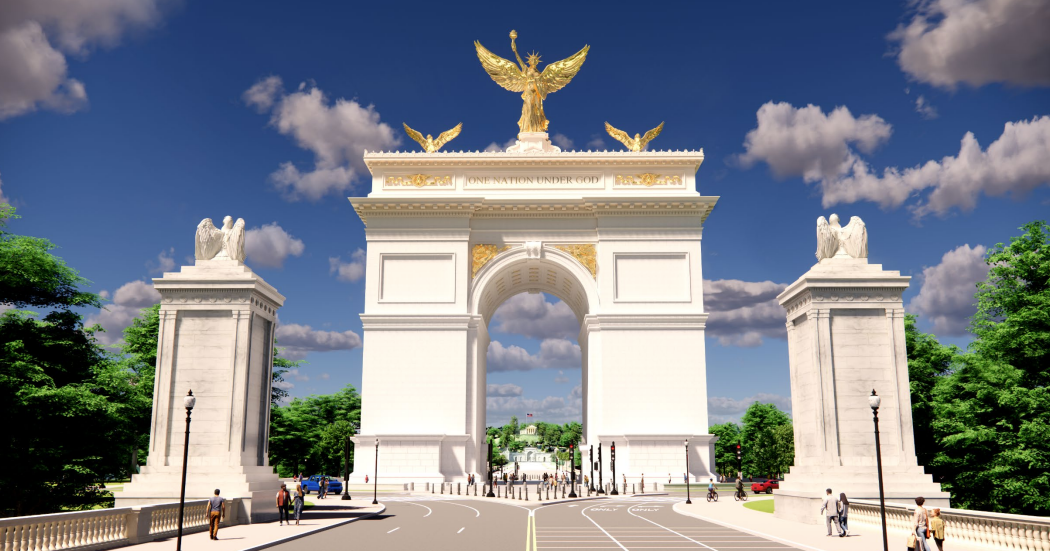
The National Capital Planning Commission (NCPC) voted 8-4 on Thursday to approve final site and building plans for a 250-foot triumphal arch to be constructed in Washington, D.C. The monument is slated for Memorial Circle, located between the Lincoln Memorial and Arlington National Cemetery. The project, which the administration states is intended to celebrate 250 years of American independence, received approval following nearly nine hours of public comments.
The NCPC serves as the federal government's planning agency for the National Capital Region. Mark Paoletta, the NCPC executive director and top lawyer for the Office of Management and Budget, recommended the approval, describing the structure as a "historic vision." The vote occurred amid ongoing legal challenges from the Commonwealth of Virginia, the District of Columbia, and a group of Vietnam War veterans who argue the project lacks congressional authorization.
The approved design features a 166-foot tall arch topped by three gilded figures—a winged female figure and two eagles—reaching a total height of 250 feet. The structure will include an observation deck and is expected to take three years to complete. While President Trump previously described the site as a military complex intended to house drones and ammunition, the documents filed with the NCPC did not include those specific military uses. The Federal Aviation Administration (FAA) determined the height poses no hazard to air navigation, provided it includes safety lighting that includes a non-standard eternal flame and continuous floodlighting.
The scale of the project involves a 250-foot structure situated in a historically significant corridor. While the specific construction costs and funding sources were not reported, the project utilizes federal land and requires federal planning oversight. The legal precedent at stake involves whether private citizens, such as the veteran plaintiffs, have "standing"—the legal right to sue—to challenge federal construction projects. This follows a prior Supreme Court finding that plaintiffs likely lacked standing in a similar challenge regarding a White House ballroom construction.
What happens next depends on the federal court system. U.S. District Judge Tanya Chutkan is currently weighing whether to issue a temporary injunction to block construction. Under a Tuesday court order, the government must notify the judge within one hour of the NCPC vote and provide a 30-minute notice before any ground-breaking or construction preparation begins. While the Justice Department indicated construction could start as early as Thursday, the Trump administration also noted that a construction company may already be arranging off-site preparations. A specific date for a ruling on the injunction has not been reported.