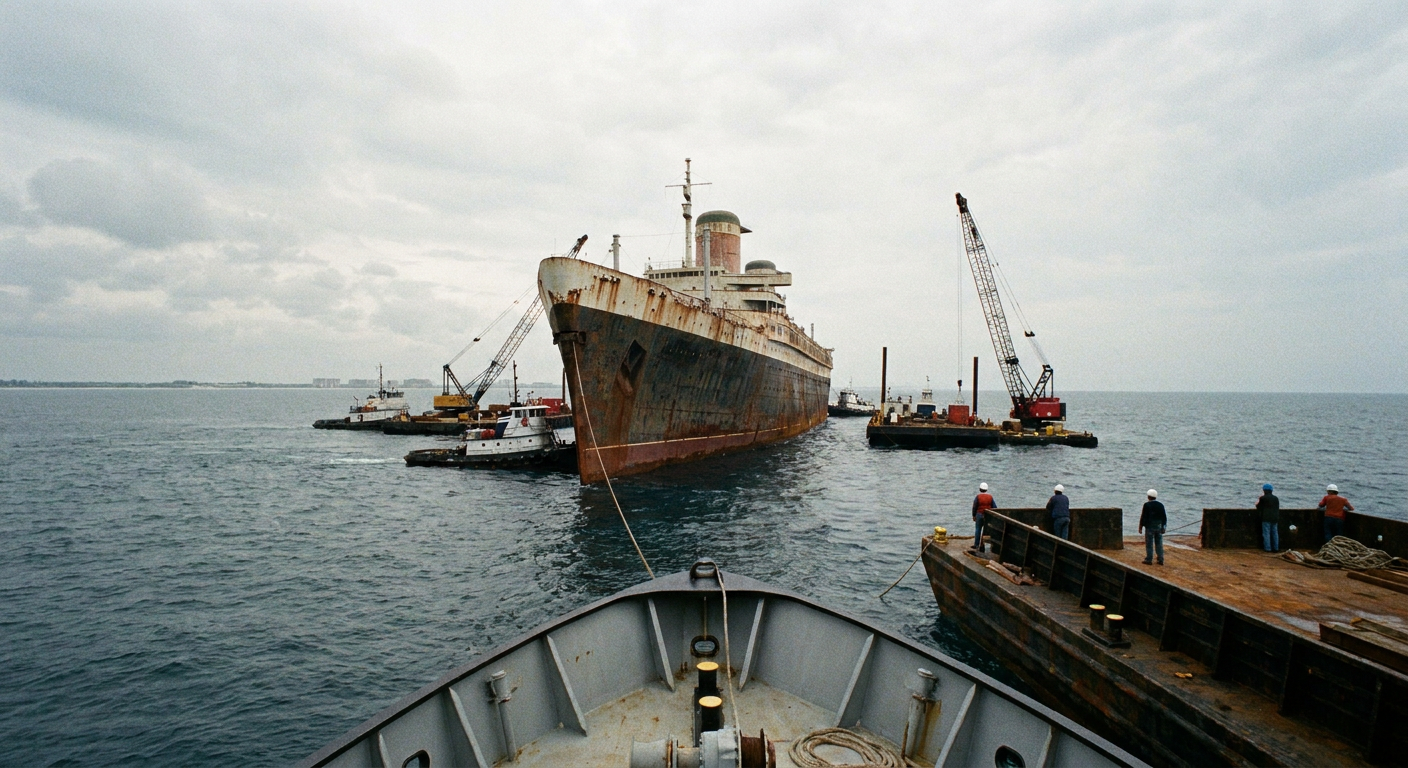
The retired ocean liner SS United States is being sunk off the coast of Florida to create the world's largest artificial reef. The nearly 1,000-foot vessel, which is longer than the Titanic, was sold to Okaloosa County, Florida, for the project after efforts to preserve it as a stationary attraction were unsuccessful.
The ship originally entered service in 1952 and broke the transatlantic speed record during its maiden voyage. Designed by William Francis Gibbs, the vessel was previously docked in Philadelphia. The SS United States Conservancy, led by the designer's granddaughter Susan Gibbs, spent several years attempting to convert the ship into a museum or hotel before determining that legal, financial, and political obstacles were too great to continue.
Coleen Marine, a company specializing in artificial reef creation, is managing the sinking process. According to team member Coleen O'Malley, the project aimed to maintain the hull's integrity so the ship remains recognizable underwater. O'Malley stated that the primary technical challenge is ensuring air escapes the vessel as it fills with water to prevent it from capsizing during its descent to the seafloor.
For recreational divers and fishers, the sinking creates a new underwater playground, though the source did not provide a specific date for when the site will be open to the public. The removal of the ship from Philadelphia also marks the end of its presence as a landmark in that city. Environmental impacts involve the creation of a permanent structure on the seabed, which O'Malley noted is designed to mirror the ship’s above-water appearance to provide a habitat for fish.
The conversion sets a precedent for how large vessels may be handled when preservation as a museum proves financially or legally unfeasible. Rather than being scrapped for metal, the ship's hull is being repurposed for conservation and tourism. The next steps involve the monitored sinking of the vessel, which was scheduled to be live-streamed, followed by the gradual colonization of the hull by marine organisms. Specific dates for future maintenance or public access were not reported.