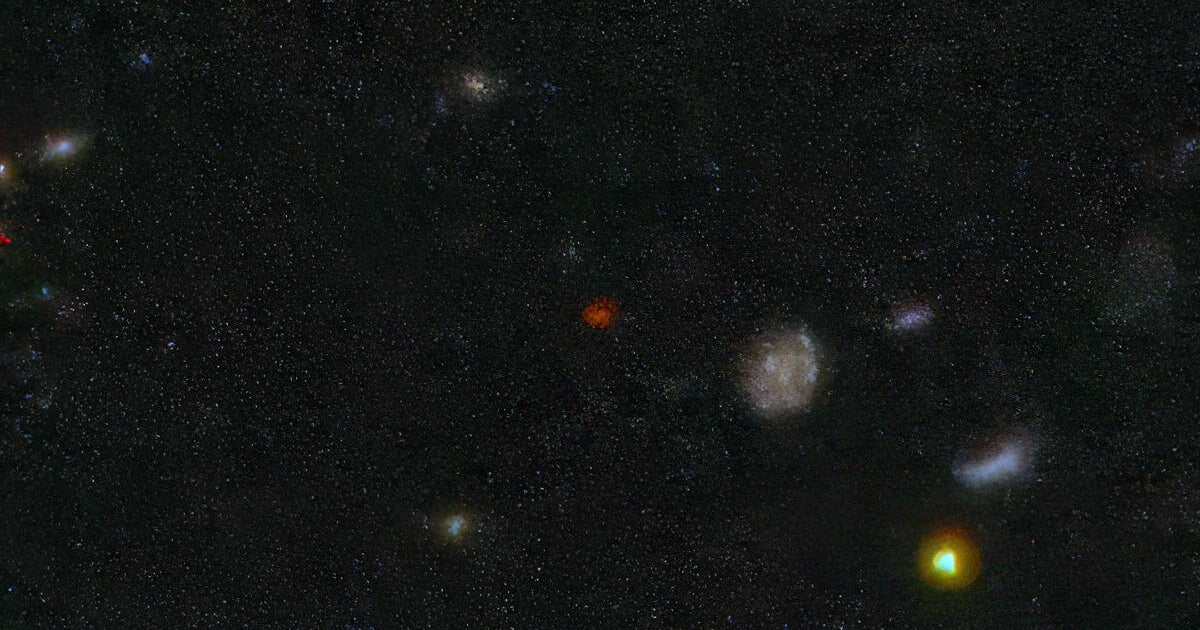
A research team led by scientists in Germany discovered the most distant quasar ever recorded, which dates back to the early stages of the universe. According to a report released on a Tuesday, the quasar formed approximately 630 million years after the Big Bang, making it the oldest such object identified to date. The discovery was published in the journal Astronomy & Astrophysics.
The findings originated from data collected by the European Space Agency’s Euclid telescope, which launched in 2023 to survey galaxies and study dark matter and dark energy. The research team, led by Julien Wolf of the European Southern Observatory, identified the object while analyzing millions of telescope observations. The discovery was subsequently corroborated by the Hubble and James Webb space telescopes along with various other observatories.
Scientists observed the quasar as it existed 13.1 billion years ago, a period when the universe was less than 5% of its current age of 13.8 billion years. The black hole at the center of this quasar has a mass equivalent to 360 million suns. Wolf noted that the discovery represents a leap in cosmic time of nearly 40 million years compared to previous records, which is the largest such advancement in nearly a decade.
The scale of this finding is measured in billions of light-years and millions of solar masses, providing a new data point for the 13.8-billion-year history of the cosmos. For the general public, this research does not result in immediate changes to daily expenses, taxes, or legal rights. Instead, the impact is felt in the field of scientific education and the long-term understanding of physics. It provides a concrete benchmark for the European Space Agency's Euclid mission, which is tasked with mapping the expansion of the universe and the influence of dark energy.
The discovery sets a precedent for using wide-field survey telescopes like Euclid to find rare, distant objects that were previously undetected. The next steps for the research team involve continued analysis of the early universe to determine if even older quasars exist. While Wolf stated the current record could be surpassed in the coming months or remain for years, observations from the Webb and Hubble telescopes will continue to be used to verify the characteristics of these distant celestial bodies. Participating institutions and the European Southern Observatory have not announced a specific deadline for the next phase of the survey.