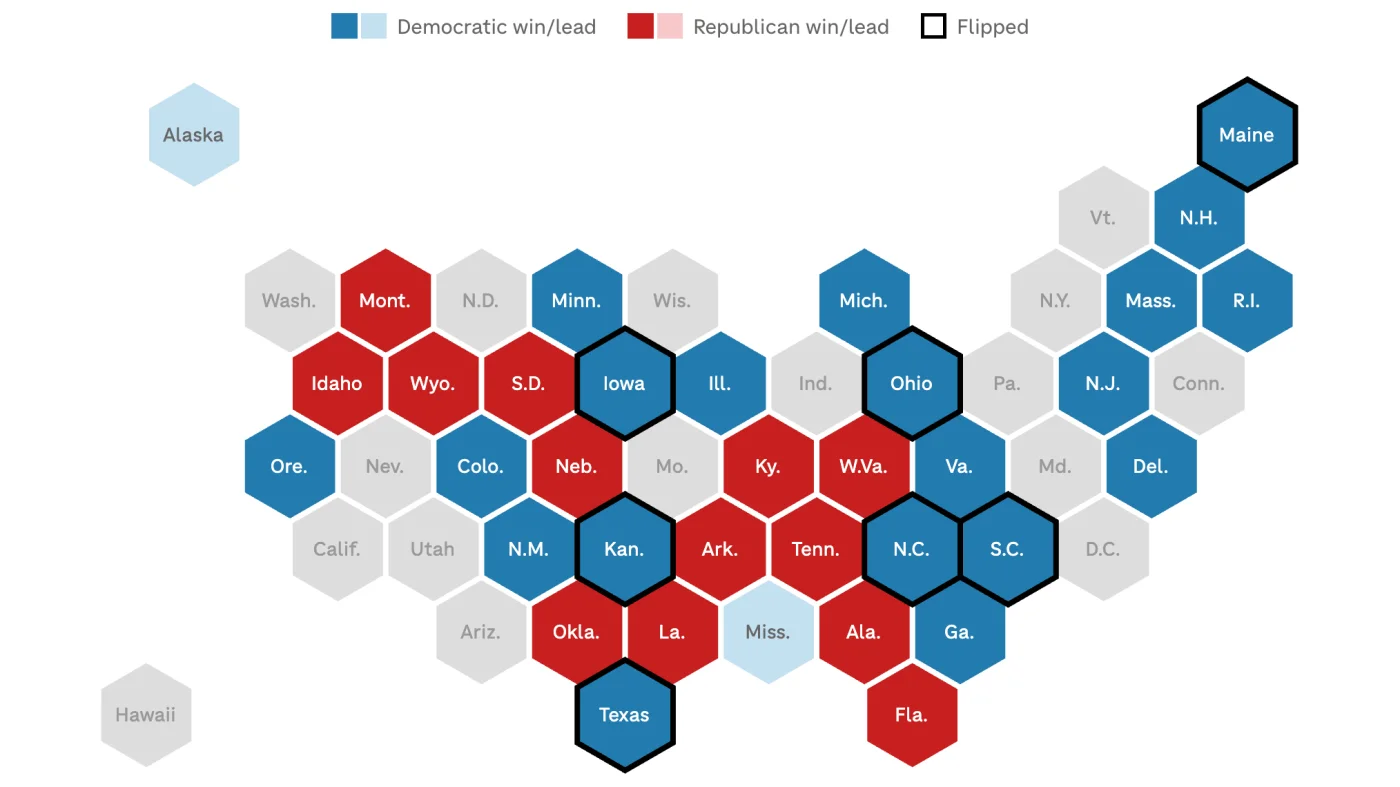
Midterm election results shifted political control across several Southern states, as Democratic candidates won U.S. Senate seats in North Carolina, South Carolina, and Texas. The elections featured high voter turnout among Black residents in states including Louisiana and Georgia. While Republicans sought to gain House seats through redistricting in Alabama, North Carolina, Texas, and Florida, the Associated Press reported Wednesday night that Republicans had secured only one of the targeted seats.
The results followed a Supreme Court ruling earlier this year that changed parts of the Voting Rights Act, leading Republican legislatures to redraw congressional maps. In Tennessee, Memphis was split into three districts, where Democratic state Rep. Justin Pearson is within a few thousand votes of winning. In Alabama, Rep. Shomari Figures won his race by nearly 8 percentage points despite a new district configuration that favored the 2024 Republican presidential nominee by 14 points.
In Georgia, Sen. Jon Ossoff (D) won by 18 points, a margin that coincided with Keisha Lance Bottoms becoming the nation’s first Black woman governor-elect. Democrats in Georgia also secured every statewide office and a majority in the state House. In North Carolina, former Gov. Roy Cooper (D) won by 20 points, contributing to potential Democratic gains in the state House and congressional delegation. Meanwhile, the U.S. Senate race in Mississippi between Democrat Scott Colom and Republican incumbent Cindy Hyde-Smith remains too close to call.
The election results affect voters and candidates across the Southern United States, particularly in Texas, Florida, Georgia, and North Carolina, which together represent more than 90 of the 270 electoral votes required to win the presidency. The shift in power involves millions of dollars in campaign investment and a change in legislative control for millions of residents. In Texas, Democrats gained a majority in the state House, while Republican supermajorities ended in Florida and South Carolina.
For individual citizens, the high turnout was linked to concerns over daily costs and legal rights. Ashley Kennedy Shelton of the Power Coalition for Equity and Justice noted that voters were motivated by rising electricity, gas, and food bills, as well as the recent Supreme Court decision affecting voting laws. In South Carolina, record participation for a gubernatorial year was reported, while in Louisiana, Democrat Jamie Davis lost by less than two percent in a Senate seat race where the Republican presidential candidate won by 15 points in 2024.
What happens next depends on final vote counts in outstanding races. In Mississippi, Scott Colom led Cindy Hyde-Smith by fewer than 1,200 votes as of the latest reports. The new Democratic majorities in the Texas and Georgia state houses will take office to begin the next legislative sessions. Leaders from both parties, including Vice President JD Vance (R) and Kentucky Gov. Andy Beshear (D), have already been active in the region.