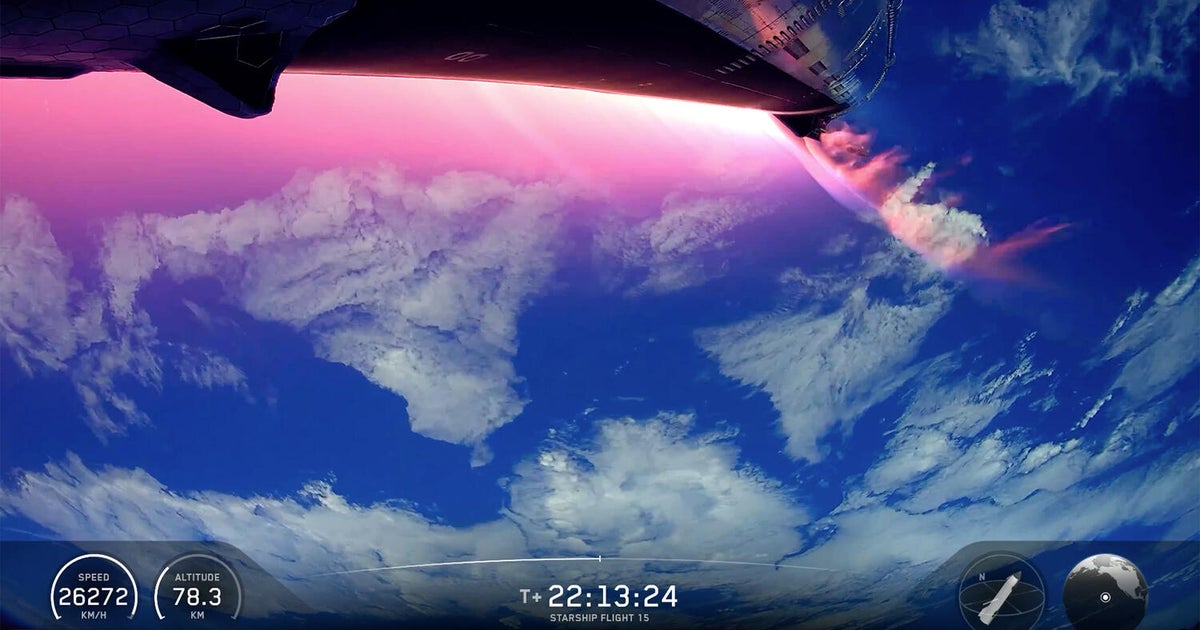
SpaceX recovered a Starship upper stage at its Texas Gulf Coast launch site following an orbital test flight. During the descent, the rocket restarted three of its six Raptor engines to transition to a vertical position and slowed to a near-hover. Two large mechanical arms on the launch gantry closed around the vehicle to capture it just before engine shutdown.
The recovery follows previous test flights that concluded with planned ocean splashdowns. This flight was the 15th test of the system, which consists of the Starship upper stage and the Super Heavy booster. Standing 407 feet tall, the two-stage vehicle is designed to be fully reusable. During this mission, the Super Heavy booster was diverted to an offshore splashdown due to a guidance issue and exploded before hitting the water, which Elon Musk attributed to "slight underperformance of engines."
Cameras mounted on the Starship's steering fins and heat-shield-covered belly captured the reentry process as the craft moved across the Baja Peninsula and northern Mexico. The vehicle endured atmospheric friction before banking toward the launch site and descending through clouds. SpaceX commentator Dan Huot described the event as a significant milestone, while commentator Jessie Anderson called the recovery an engineering feat.
The rocket is capable of generating 16 million pounds of thrust from 33 first-stage engines. For the federal government and NASA, the stakes involve the feasibility of the 2028 lunar mission date. NASA officials stated they are open to using the Blue Moon Mark 2 lander from Blue Origin as an alternative depending on which spacecraft is ready in time. For the broader space industry, successful reusability is intended to lower the cost of transporting payloads to orbit.
Future operations will focus on orbital fueling tests scheduled for the next several Super Heavy-Starship flights. While Musk stated that the loss of the booster during this test does not change the timeline for high-volume flights, the development process has taken longer than initially projected. The next steps involve refining performance and guidance systems while continuing to test the recovery mechanisms.