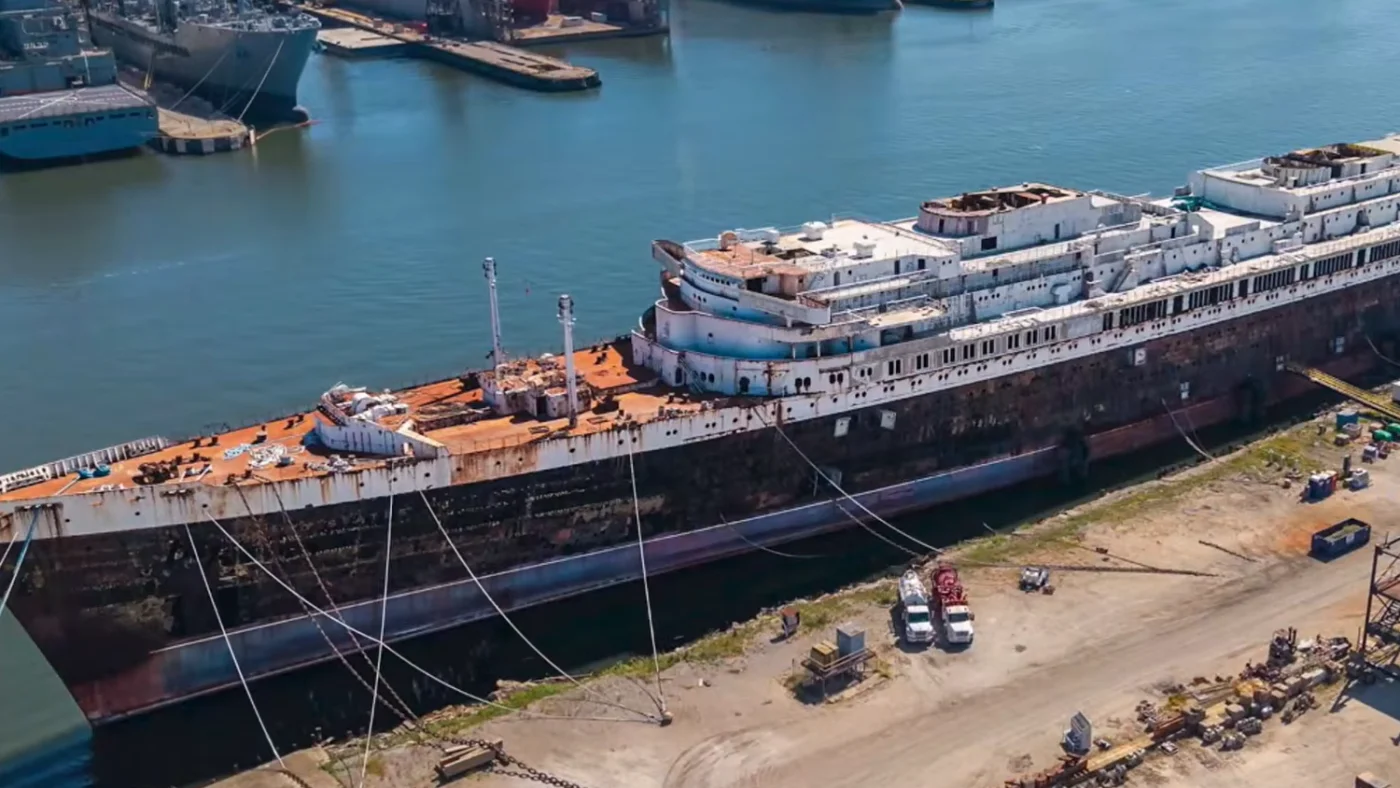
The SS United States, a 1,000-foot-long ocean liner that once held the transatlantic speed record, was sunk off the Florida coast on Wednesday to become what is expected to be the world’s largest artificial reef. Crews scuttled the vessel approximately 20 nautical miles from Destin-Fort Walton Beach by removing hull plugs and allowing it to fill with water without the use of explosives. The sinking process lasted five hours, ending in the evening with the ship dipping below the waves to its final location on the ocean floor.
The vessel was launched in 1951 and served for two decades, transporting four U.S. presidents and numerous celebrities before its retirement in 1969. It remained docked in Philadelphia starting in 1996, where it sat for decades before the SS United States Conservancy sold it to Okaloosa County for $1 million in 2024. Prior to the sinking, the ship underwent a preparation process in Mobile, Alabama, to remove toxic materials, fuel, and wiring in coordination with the Environmental Protection Agency (EPA) and the Florida Department of Environmental Protection.
Okaloosa County officials funded the project using local tourist tax revenue, positioning the ship as a centerpiece for the region's marine ecosystem and diving industry. The county already manages approximately 580 artificial reefs, the highest concentration in the United States. Tourism director Jennifer Adams stated that the ship was placed so its upper decks remain within recreational diving limits to attract tourists who will spend money on lodging, food, and equipment.
For local residents and the regional economy, the change will be a projected increase in year-round tourism. The National Oceanic and Atmospheric Administration (NOAA) previously found that diving tourism at a small number of reefs generated nearly $1 billion in annual benefits in 2017. However, University of Florida economist Andrew Ropicki noted that while the region has a "critical mass" of reefs to capture tourism dollars, overinvestment could eventually lead to diminishing returns if visitor interests shift. The project also sets a precedent for the "dignified solution" of reefing large historic vessels rather than sending them to a scrapyard, according to Susan Gibbs of the SS United States Conservancy.
The next steps involve monitoring the site as a habitat for marine life and a destination for the diving public. The SS United States joins the 888-foot USS Oriskany, an aircraft carrier sunk in 2006, making the Florida Panhandle home to the two largest artificial reefs in the world. Okaloosa County plans to continue this strategy, with tourism officials stating that five or six additional artificial reefs are already in development.