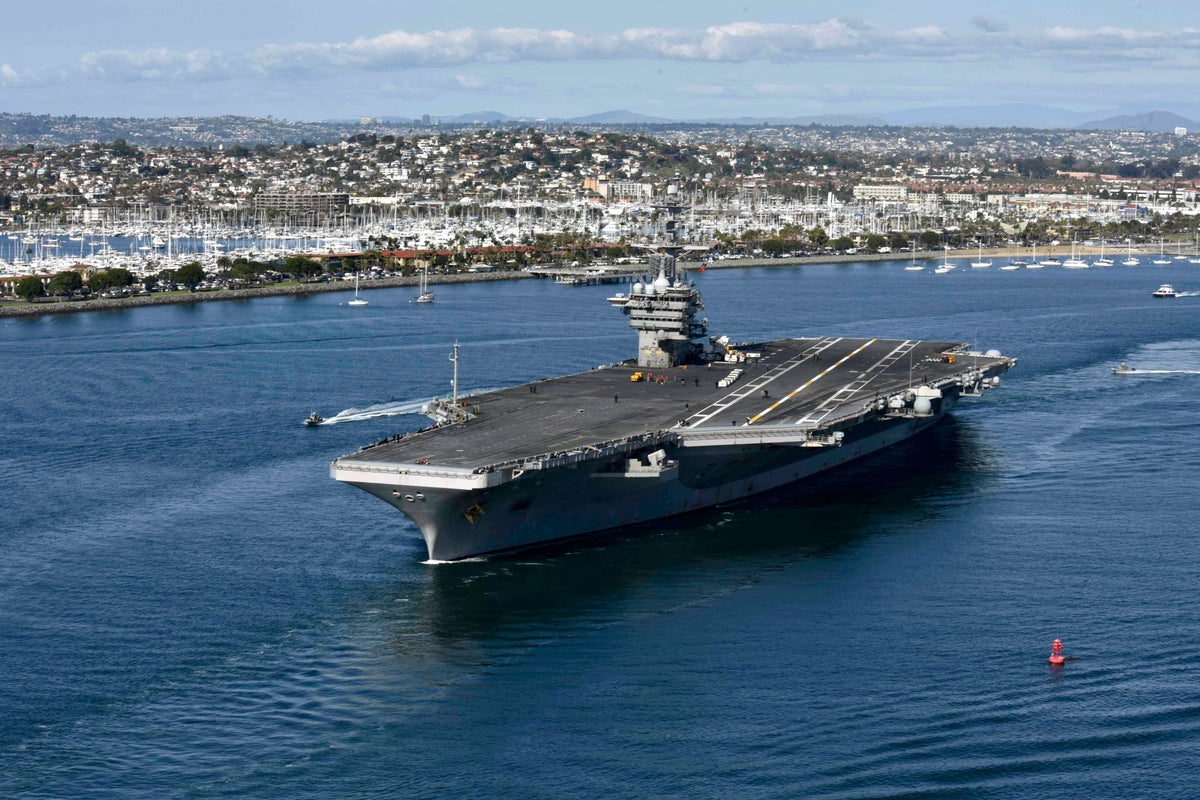
U.S. Central Command announced on Monday, November 16, 2026, that the aircraft carrier USS Theodore Roosevelt has arrived in the Middle East. The ship joins the USS George H.W. Bush and the USS George Washington, bringing the total number of American aircraft carriers operating simultaneously in the region to three.
The naval buildup occurs as President Donald Trump offers varying assessments of the more than eight-month-old conflict with Iran. While the president stated last week that the war "militarily is effectively over" following a meeting with the prime minister of Qatar, he also told broadcaster Hugh Hewitt on Thursday, November 12, that he "would not hesitate" to respond if negotiations do not proceed as planned. Trump recently warned Iran that U.S. forces are "locked and loaded" while monitoring Pickaxe Mountain, a site associated with Iran's nuclear program.
The USS Theodore Roosevelt departed San Diego in September to join a naval force in the Arabian Sea that includes 13 destroyers, two cruisers, and a littoral combat ship. The carrier is accompanied by the USS Makin Island amphibious readiness group, which carries approximately 2,000 Marines, though those specific vessels have not yet reached the region. This marks only the second time since 2003 that the U.S. Navy has positioned three carrier strike groups in the area.
For commercial sailors and shipping companies, the day-to-day reality involves physical risk. U.S. Central Command reported it has redirected 150 merchant vessels and disabled five since June as part of its blockade on Iranian shipping. Conversely, Iranian state television reported on Monday, November 16, that U.S.-escorted routes are hazardous due to mines. Revolutionary Guard officials claimed that mines damaged six tankers since Sunday, November 15, resulting in oil pollution along the coast. On the same day, the United Kingdom Maritime Trade Organization reported a projectile hit a tanker's engine room, causing a fire.
The military escalation follows U.S. midterm elections where the Republican Party saw losses that Vice President JD Vance attributed to public opposition to the war. While Trump has directed Vance to refocus on domestic policy, a resolution remains stalled. Iran has demanded the lifting of the oil export blockade as a condition for a deal, while Trump maintains that any agreement must address Iran's nuclear program. No specific date for the resumption of formal negotiations has been reported.