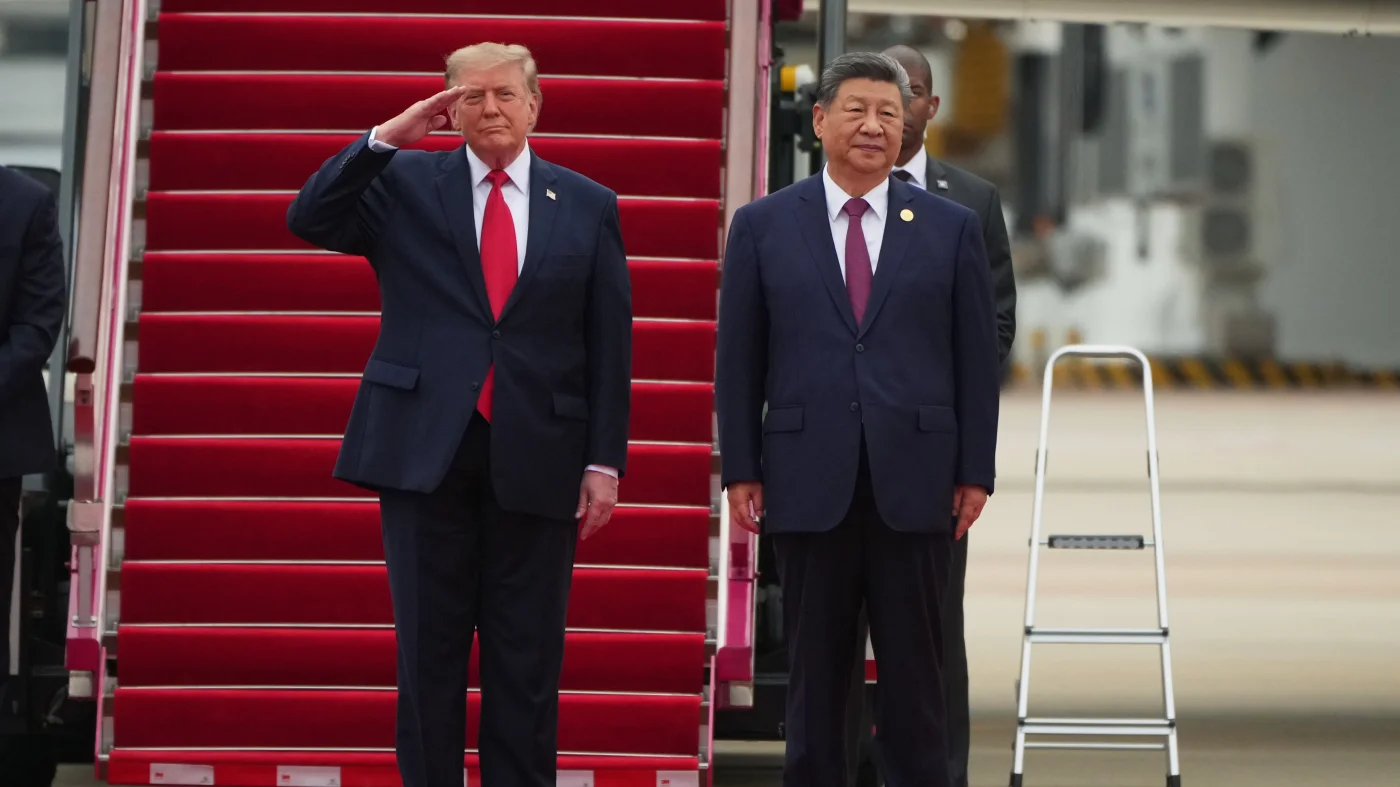
President Donald Trump arrived in Shenzhen, China, on Wednesday, November 18, 2026, for the Asia-Pacific Economic Cooperation (APEC) summit. Upon landing, he was greeted on the tarmac by Chinese President Xi Jinping, a gesture reciprocating Trump's welcome of Xi in Washington this past September. The visit is centered on high-level diplomacy, including a scheduled trilateral meeting on Thursday between Trump, Xi, and Russian President Vladimir Putin to discuss nuclear weapon limits and the war in Ukraine.
The diplomatic mission began as the U.S. government addressed a series of technical outages affecting Microsoft, JPMorgan Chase, the Federal Aviation Administration (FAA), and the National Security Agency’s communications network. While Trump initially characterized the outages from Manila on Tuesday as a consequence of being a "big and powerful" nation, Secretary of State and National Security Adviser Marco Rubio stated on Wednesday that there is "zero" evidence the disruptions were caused by hackers or rival nations. Rubio attributed the issues to "short-term disruption" resulting from system updates intended to fix identified vulnerabilities.
In Manila prior to his arrival in China, Trump met with Philippine President Ferdinand Marcos Jr. for lunch at the Malacañang Presidential Palace. Following the meeting, Trump announced that the U.S. and the Philippines had reached a new trade deal involving Manila purchasing more American energy and agricultural products. This follows a similar announcement of an agreement last year; U.S. Census Bureau data shows the U.S. trade deficit with the Philippines rose from $4.9 billion in 2024 to $12.8 billion during the first nine months of 2026.
The summit also addresses the rapid development of artificial intelligence (AI), which affects national security and global economic growth. The U.S. tech industry remains under scrutiny following the removal of Nvidia CEO Jensen Huang, who admitted to an affair with a woman alleged to be a Chinese agent. This incident has raised questions for U.S. policymakers regarding China's access to advanced computer chips—largely manufactured in Taiwan—which are essential for developing AI models that compete with American technology.
For U.S. citizens, the immediate impact is seen in the technical reliability of essential services. The reported outages have disrupted access to bank accounts, email, and air travel. While the FAA blamed a Friday ground stop on equipment issues during a network upgrade, the continued instability of these systems highlights the vulnerability of the domestic digital infrastructure. The administration’s ability to resolve these technical flaws, or "patching," will determine when regular service for banking and transportation returns to normal.
Trump indicated he does not plan to raise the issue of Taiwan’s sovereignty during his meetings, though he stated he expects President Xi to bring it up. Additionally, Secretary Rubio confirmed that Trump is serious about a potential meeting with North Korean leader Kim Jong Un to resolve regional tensions, though no such meeting was scheduled for Thursday. Following the APEC summit, the U.S. administration will face continued pressure to curb China's $1 trillion trade surplus, which has persisted despite existing U.S. tariffs.