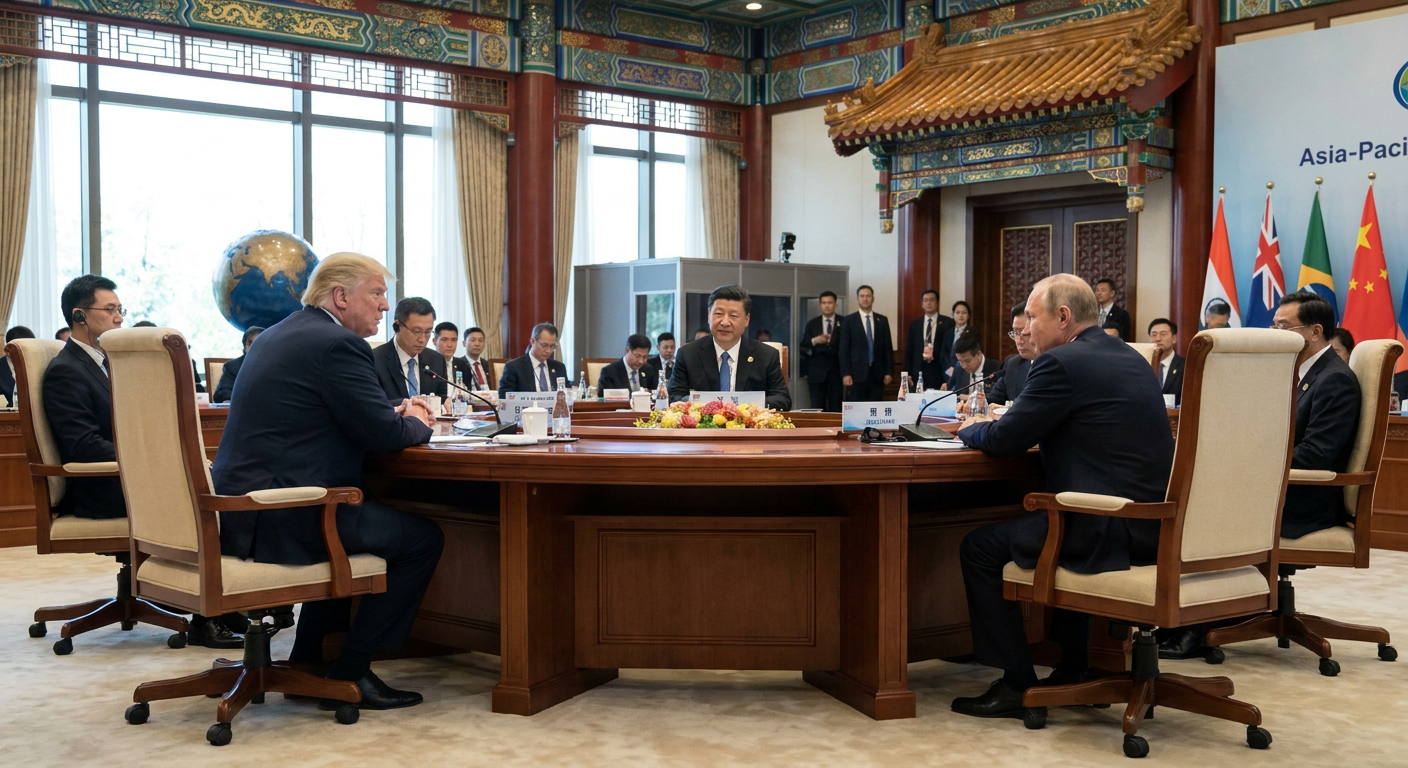
President Donald Trump is scheduled to meet with Chinese leader Xi Jinping and Russian President Vladimir Putin during the Asia-Pacific Economic Cooperation (APEC) summit in Shenzhen, China. While the Trump administration stated that nuclear proliferation is on the official agenda, analysts expect the meetings to focus on the current status of U.S.-China relations. The summit follows the departure of NVIDIA CEO Jensen Huang, who reportedly left the company after revelations concerning a relationship with a woman suspected of having ties to Chinese intelligence.
The leadership meeting comes as the U.S. and China maintain a temporary trade truce. China recently extended its pause on rare earth export restrictions for two months, moving the deadline to January 10. In a reciprocal action, the United States extended tariff exclusions on 178 Chinese products until the same date. Evan Osnos, a staff writer for The New Yorker, noted that both nations have internal reasons for avoiding a broader trade conflict, including domestic economic concerns in China and the political fallout of tariffs in the United States.
China's domestic economy is currently managing the effects of a property market collapse that has left an estimated 90 million houses vacant. Additionally, youth unemployment in China has exceeded 20% at various points. In the United States, the Republican party faced losses in the recent midterm elections, which Osnos attributed in part to the impact of international tariffs. Following those elections, President Trump will face a Democrat-controlled Congress starting in January for the final two years of his term.
The scale of the economic issues involved is significant, with China's property surplus of 90 million empty homes representing enough housing for the entire population of Russia. For U.S. voters, the economic stakes are tied to recent political shifts; Osnos reported that the electorate has signaled a desire to avoid price increases driven by trade disputes. The shift to a Democrat-controlled Congress in January means the Trump administration will have less legislative flexibility to navigate these trade tensions or implement new economic policies without bipartisan support.
The meeting also sets a precedent for how the U.S. government handles technology security following the departure of Jensen Huang, who had served as a primary advisor to the president on chip technology for two years. This personnel change leaves the administration with what Osnos described as "scrambled" inputs on semiconductor policy just as the summit begins. What happens next depends on the discussions in Shenzhen; the current trade extensions remain in effect until January 10, which serves as the next major deadline for both rare earth exports and U.S. tariff exclusions.