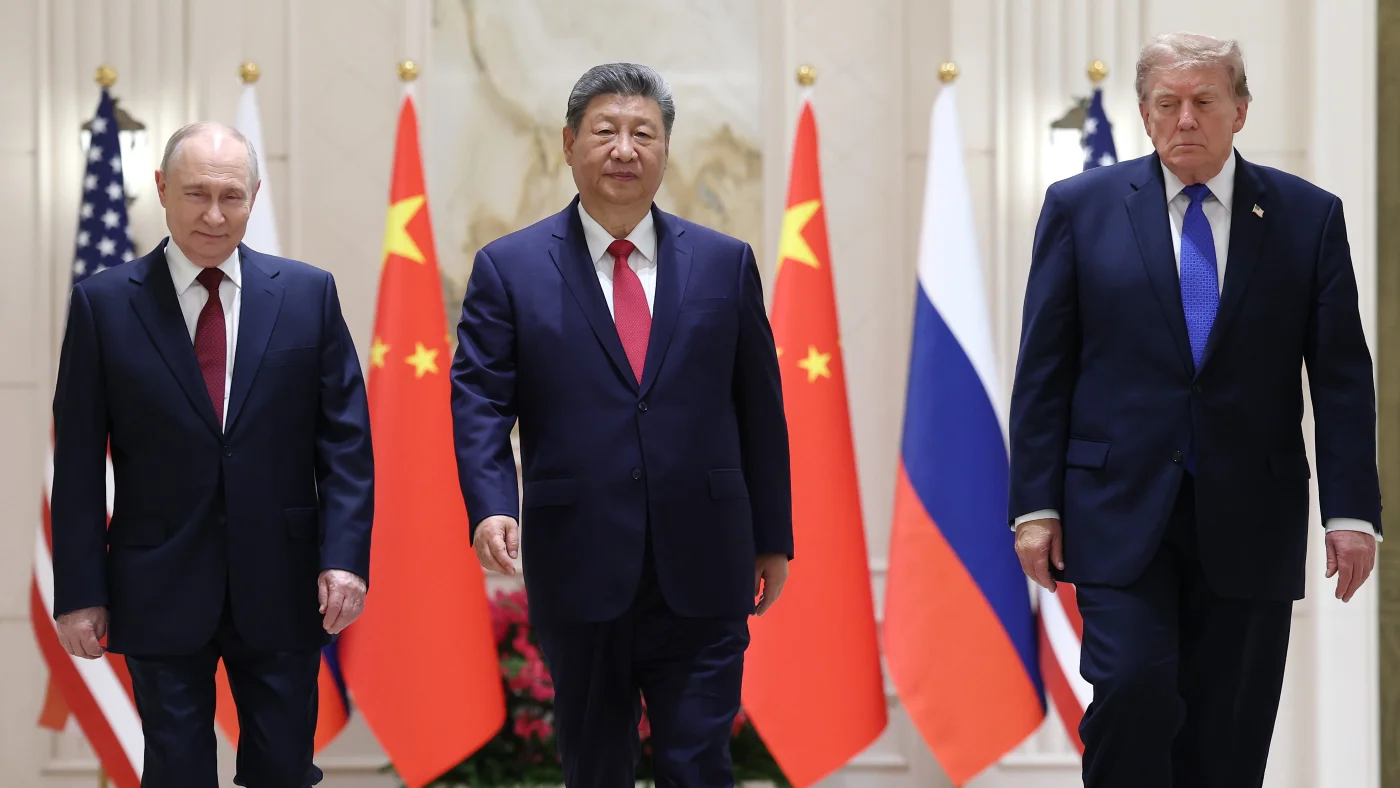
President Donald Trump met with Chinese President Xi Jinping and Russian President Vladimir Putin for a trilateral summit in Shenzhen, China, on Thursday, November 19, 2026. This gathering marked the first time in U.S. history that an American president held a joint meeting with the leaders of China and Russia. The session was held on the sidelines of the Asian Pacific Economic Cooperation (APEC) conference and follows a proposal first made by Putin during a phone call with Trump in October.
The three leaders delivered opening remarks emphasizing the importance of cooperation among major powers for global stability. Xi stated that when great powers are at peace, the world is secure, while Putin suggested their nations could significantly contribute to global security. Trump described the meeting as a "special responsibility" and characterized his relationships with both leaders as personal, referring to Putin as his "friend" and telling Xi that there would be no problems as long as they remained in charge.
The official agenda included nuclear disarmament, the war in Ukraine, and Iran's nuclear program, though the leaders entered with divergent priorities. Trump sought to include China in arms control negotiations, which Beijing has previously rebuffed, citing its smaller arsenal compared to those of the U.S. and Russia. Putin advocated for a settlement to the Ukraine conflict on terms favorable to Moscow, including a redrawn security map of Europe. Xi prioritized general themes of economic stability and a "multipolar world" while criticizing the use of sanctions.
The trilateral session lasted 90 minutes, following separate bilateral talks between the participants. Trump's meeting with Putin lasted 42 minutes, while his discussion with Xi went for approximately one hour. On Wednesday, November 18, Xi and Putin held a private two-hour meeting. Despite the high-level dialogue, no specific solutions for the conflicts in Ukraine or Iran were announced, and Trump declined to answer questions regarding allegations of Chinese involvement in an espionage plot involving Nvidia technology.
The scale of the issues discussed involves the security of millions of people across Europe and the Middle East, specifically regarding the ongoing war in Ukraine and Iran's nuclear capabilities. While the leaders discussed these topics, the lack of a formal agreement means that current military and economic conditions—including sanctions and active combat—remain unchanged. Renters, small-business owners, and families in conflict zones will not see immediate relief in prices or safety based on these preliminary talks.
What happens next depends on the follow-up by specialized envoys. For the United States, Trump has tasked real estate developer Steve Witkoff and his son-in-law Jared Kushner with managing the complexities of a potential Ukraine peace deal. Meanwhile, the conflict in Ukraine continues on the ground; on Thursday, Ukraine conducted its third missile strike of the week on the bridge connecting mainland Russia to Crimea, disabling the structure. Further diplomatic developments may be influenced by the shifting political landscape in Washington when the new Congress convenes in January.