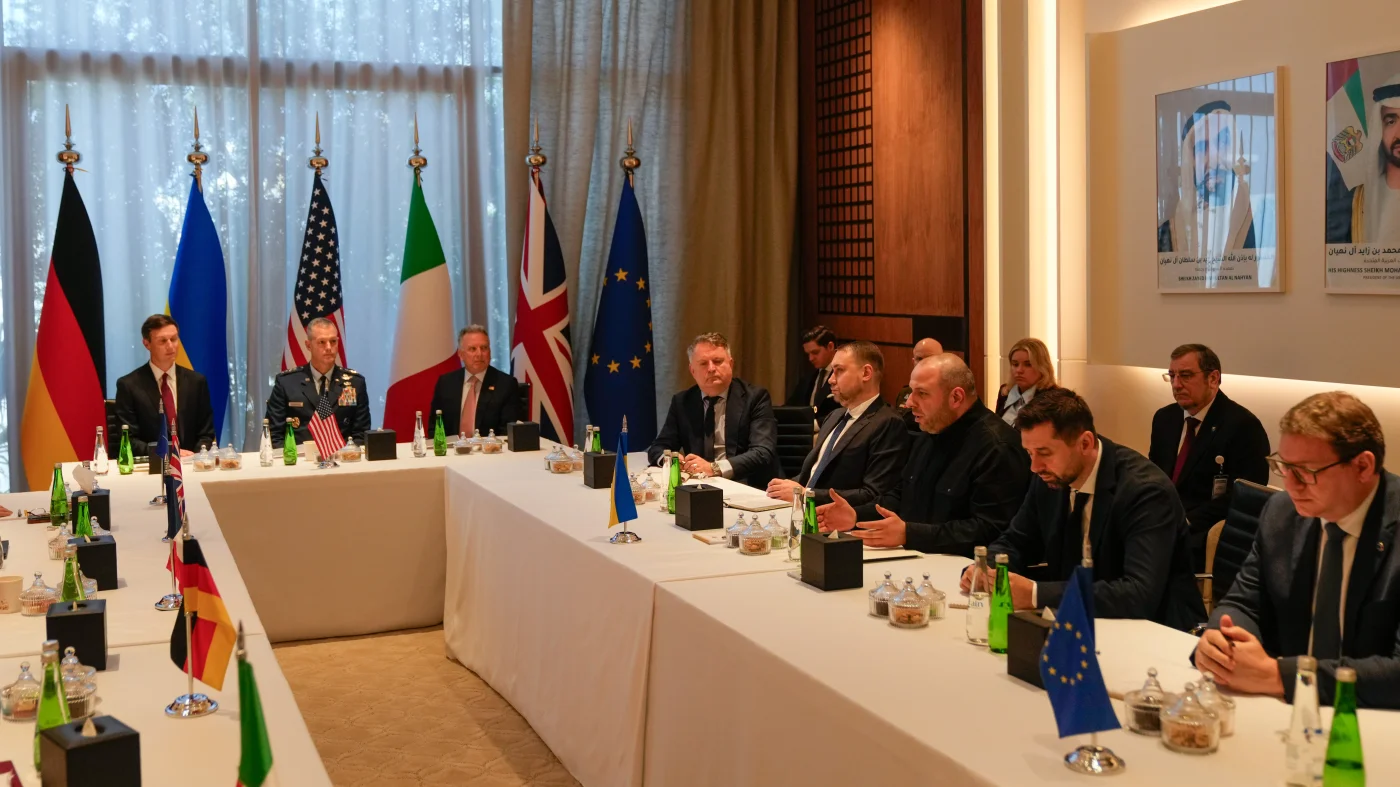
Delegations from Russia and Ukraine held a four-hour meeting mediated by U.S. officials in Abu Dhabi on Tuesday, marking the first such trilateral session in nine months. U.S. Secretary of State Marco Rubio described the talks as "very productive," while Ukrainian President Volodymyr Zelenskyy called the session "constructive and quite substantive." The talks focused on security guarantees and humanitarian issues, including prisoner exchanges and the return of civilians and children.
The meeting comes as the conflict enters its fifth year with both sides reporting heavy drone activity. On Tuesday, Ukraine's air force stated Russia launched 162 drones and a ballistic missile, while Russia's Defense Ministry reported downing 155 Ukrainian drones. Previous diplomatic efforts in early 2026 yielded no significant breakthroughs, and talks had largely stalled after the U.S. began military operations with Israel against Iran.
Representing the U.S. in Abu Dhabi were Jared Kushner, son-in-law to President Donald Trump, and envoy Steve Witkoff. The Ukrainian delegation was led by Rustem Umerov, head of the foreign intelligence service, and included chief of staff Kyrylo Budanov. Russia’s team was led by presidential aide Vladimir Medinsky. Kushner stated the goal is to create a "new framework" for lasting peace, suggesting a broader agreement involving European security arrangements.
The scale of the diplomatic effort involves the world's major powers, with the U.S. attempting to broker a "grand deal" that would redefine security for the entire European continent. However, the costs of a potential settlement remain a point of domestic political friction. President Zelenskyy reported that U.S. mediators asked if Kyiv would "trade the Donbas for security," a proposal involving the four regions Russia claimed to annex in 2022. While such a deal could theoretically end active combat, Zelenskyy expressed skepticism that territorial concessions would prevent future invasions without full NATO membership, which he noted the U.S. has not yet been willing to offer.
What happens next: A second day of talks is scheduled for Wednesday in Abu Dhabi. While Russian Foreign Minister Sergey Lavrov has rejected European calls for an immediate ceasefire, U.S. officials indicated they will continue working toward a "comprehensive and lasting settlement." In Washington, the political landscape will shift in January 2027 when Democrats take control of the U.S. Congress, a move that may change the level of support or the conditions placed on U.S. involvement in the conflict. No specific deadline for a final peace agreement has been set.