The Plain Record

Neutral daily news — clear headlines, complete facts.

National

Voyager 1 Spacecraft Reaches Distance of One Light-Day From Earth

NASA's Voyager 1 probe reached a distance of more than 16 billion miles from Earth, marking a milestone of one light-day of travel.

By The Plain RecordUpdated November 20, 2026 at 2:06 AM EST
Published November 15, 2026 at 6:05 PM EST

The short answer

NASA's Voyager 1 probe reached a distance of more than 16 billion miles from Earth, marking a milestone of one light-day of travel. NASA reported that its Voyager 1 spacecraft reached a distance of one light-day from Earth on a Wednesday.

Updates (3)

  • Update — November 20, 2026 at 2:06 AM EST: NASA's Voyager 1 probe has reached a distance of 16 billion miles from Earth, requiring a full day for radio signals to reach flight controllers.
  • Update — November 18, 2026 at 6:35 AM EST: NASA’s Voyager 1 probe has reached a distance of 16 billion miles from Earth, becoming the first human-made object to be one light day away.
  • Update — November 18, 2026 at 5:50 AM EST: NASA's Voyager 1 has reached a distance of one light-day from Earth, requiring a 24-hour wait for radio signals to travel one way.
Voyager 1 Spacecraft Reaches Distance of One Light-Day From Earth

The Facts

Who
NASA and the Voyager 1 spacecraft
What
Voyager 1 reaching a distance of one light-day (more than 16 billion miles) from Earth.
When
Wednesday at 5:16 a.m. ET (Projected)
Where
Interstellar space, more than 16 billion miles from Earth
Why
To mark a milestone in the longest-running space mission and the probe's status as the most distant human-made object.

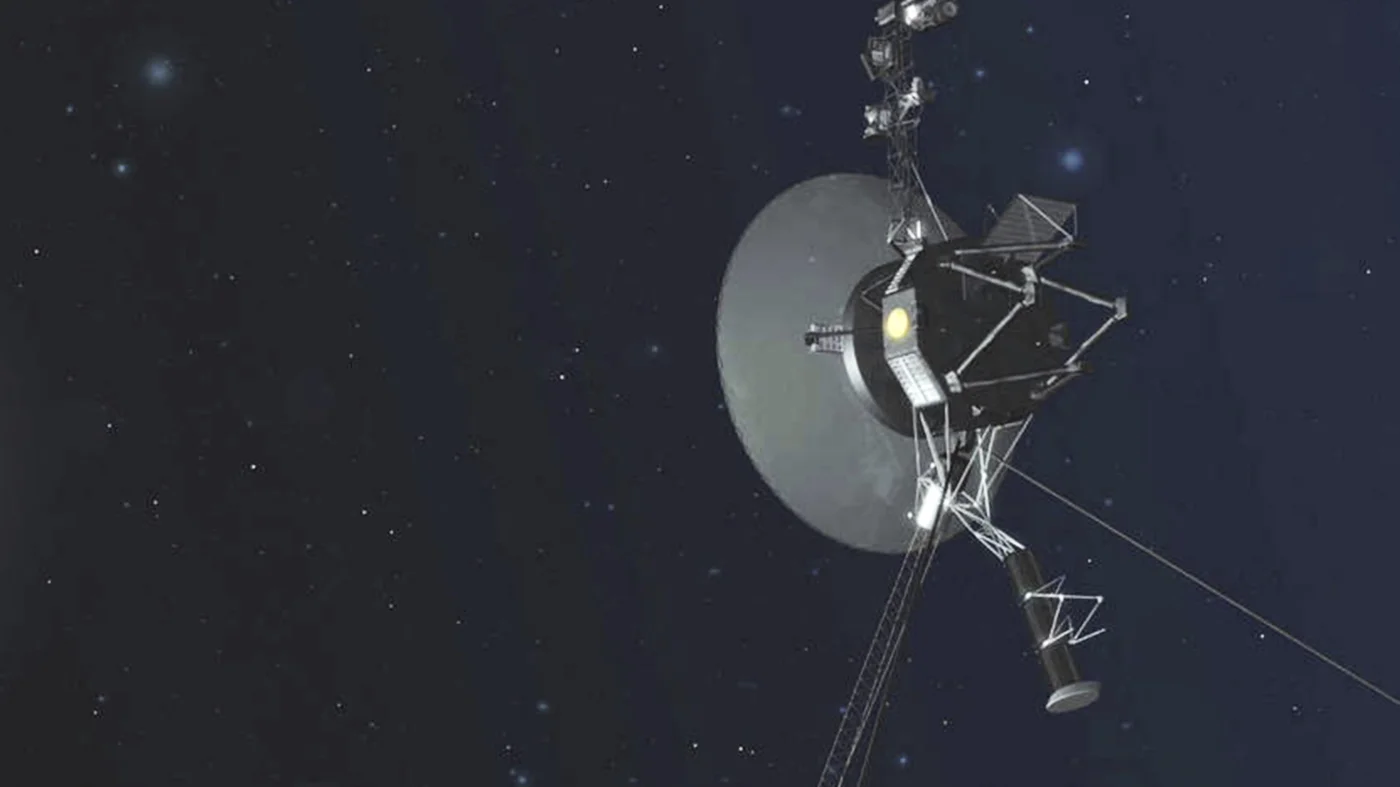
NASA reported that its Voyager 1 spacecraft reached a distance of one light-day from Earth on a Wednesday. The probe, which is the most distant human-made object in space, was more than 16 billion miles away from its home planet at that time.

Voyager 1 was launched on September 5, 1977, and has been traveling for nearly 50 years. During its mission, it conducted flybys of Jupiter and Saturn, where it discovered Jupiter's faint ring system in 1979 and photographed Saturn’s rings and moons in 1980. On February 17, 1998, it became the most distant human-made object after overtaking the Pioneer 10 probe.

The spacecraft reached the interstellar boundary in 2012. It and its twin, Voyager 2, are the only two spacecraft to operate outside the heliosphere, a region that serves as a protective shield for the solar system. Voyager 1 continues to measure magnetic fields and plasma waves in interstellar space, though NASA recently deactivated its Low-energy Charged Particles (LECP) experiment to conserve the probe's remaining power.

The scale of this event is measured in the distance of more than 16 billion miles, or one light-day. A light-day is the distance light travels in 24 hours. This highlights the technical challenges of maintaining contact with technology that was launched nearly half a century ago. To mark the distance, NASA organized a symbolic event asking the public to blink "V-G-R" in Morse code toward the sky using flashlights or mobile phones.

The long-term impact involves the eventual loss of the probe's functions as power diminishes. By shutting off the LECP earlier this year, NASA engineers are attempting to extend the operational life of the remaining instruments. Beyond its scientific data, the probe carries the Golden Record, a gold-plated copper disk containing 115 images and sounds from Earth intended for potential discovery by extraterrestrials. Voyager 1 was projected to hit the specific light-day mark at 5:16 a.m. ET on Wednesday, continuing its trajectory away from the solar system.

Timeline of what happened

Key dates and decisions, in the order they occurred.

  1. September 5, 1977

    Voyager 1 launched into space

  2. 1979

    Voyager 1 discovers Jupiter's ring system

  3. 1980

    Detailed photos taken of Saturn's rings and moons

  4. February 17, 1998

    Voyager 1 overtakes Pioneer 10 as most distant object

  5. 2012

    Voyager 1 reaches the interstellar boundary

Summaries are written by The Plain Record to state the facts of a story plainly and without political slant. Drafted with AI assistance and checked against the source record before publication. See how we report, or report a correction.

← Back to the front page

Questions readers ask

What happened: Voyager 1 Spacecraft Reaches Distance of One Light-Day From Earth?

Voyager 1 reaching a distance of one light-day (more than 16 billion miles) from Earth.

Who is involved?

NASA and the Voyager 1 spacecraft

When did this happen?

Wednesday at 5:16 a.m. ET (Projected)

Where did this happen?

Interstellar space, more than 16 billion miles from Earth

Why does this matter?

To mark a milestone in the longest-running space mission and the probe's status as the most distant human-made object.